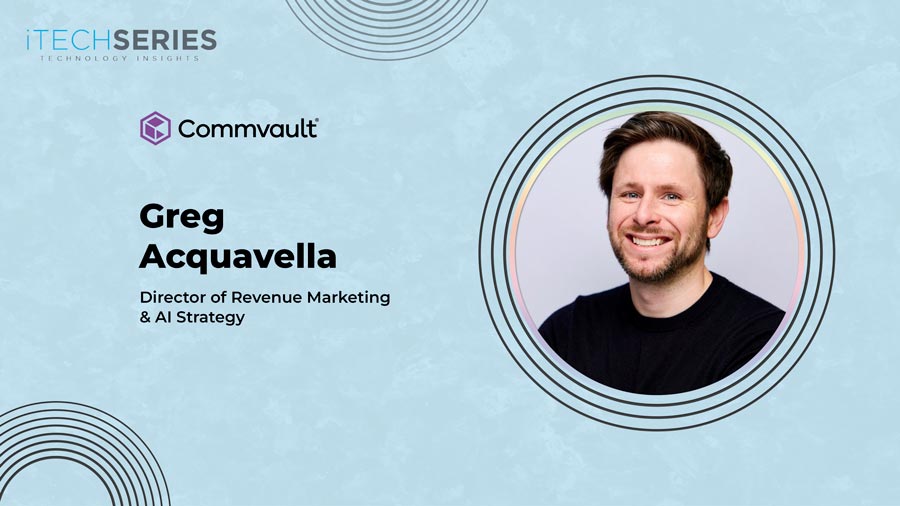
Greg Acquavella, Director of Revenue Marketing & AI Strategy at Commvault, shares his journey across ABM/ABX, field, and revenue marketing within complex enterprise environments. He discusses how he connects marketing strategy to real revenue impact, modernizes go-to-market motions through account-based experiences, and aligns marketing, sales, and field teams to drive pipeline growth and measurable business outcomes.
Greg, it’s great to have you on this interview. Tell us about yourself and your journey as a go-to-market leader.
I’ve spent my career focused on one core question: how do we connect marketing strategy to real revenue impact?
My journey as a go-to-market leader has taken me across demand generation, ABM/ABX, field marketing, and revenue marketing roles, primarily in complex B2B and enterprise environments. What’s shaped my perspective most is working inside large, global organizations where success depends on alignment, not just within marketing, but across sales, operations, and field teams.
At Commvault, my focus has been on modernizing how we go to market by shifting away from lead-centric thinking and toward an account-based, experience-driven model. That means designing marketing motions that reflect how buyers actually behave today: non-linear journeys, multiple stakeholders, and a strong expectation for relevance and timing.
How do you ensure that your digital and field marketing strategies are aligned to drive revenue and pipeline growth?
Alignment starts with treating the needs of the account and understanding account behavior. From there, you can then have conversations across the business to ensure everyone is working together in lockstep towards a singular goal.
Digitally, we use intent, engagement, and buying-stage signals to guide how accounts move through campaigns and experiences. Field marketing then becomes the activation layer, not just a campaign tactic, but rather a strategic partner in execution. Every campaign is packaged with clear guidance on how field teams should activate based on account tier, region, and buying stage.
We also operationalize this alignment through shared signals and workflows. When an account shows intent or moves stages, digital programs, SDRs, and field marketers are all working from the same data, often delivered via real-time Slack alerts and workflows. That shared visibility keeps everyone focused on the same goal: advancing the account toward pipeline and revenue, not just generating activity.
How do you differentiate effective ABM strategies from overused marketing campaigns?
Effective ABM, or ABX as I prefer, isn’t about personalization for personalization’s sake. And it’s definitely not about running “fancier” campaigns.
The difference comes down to intent, orchestration, and restraint.
Overused campaigns push the same message broadly and hope relevance sticks. Effective ABX listens first. It uses signals like intent data, website behavior, and engagement history to determine when and how to engage. It also respects the buyer, especially for technical and security audiences, by avoiding gimmicky 1:1 tactics that feel forced.
In practice, this means focusing on 1: few and 1: many ABX motions that are buying-stage aware, persona-aware, and field-enabled. The goal isn’t to chase every account. It’s to concentrate effort on accounts that are actually in the market and ready to engage. And to meet them with substance rather than noise.
In your experience, how has marketing’s role evolved in influencing pipeline and closing deals, especially in enterprise sales?
Marketing’s role has shifted from being a lead supplier to becoming a strategic revenue partner.
In enterprise sales, deals are rarely won because of a single form fill or campaign. They’re won because marketing builds credibility early, shapes the narrative throughout the buying journey, and supports sales at key moments with the right insights, content, and context.
Today, marketing influences deals by:
- Educating buying groups before sales are ever engaged
- Creating air cover through consistent, relevant messaging
- Providing sales and field teams with real-time signals on when accounts are heating up
- Supporting late-stage deals with validation, proof points, and executive-level engagement
In short, marketing no longer just opens doors; it helps guide buyers through them and supports sales all the way to close.
“Marketing has shifted from being a lead supplier to becoming a strategic revenue partner.”
Can you walk us through how you define and measure success in your ABM programs? What are the key indicators that tell you your strategy is working?
We measure ABX success at two levels: campaign performance and account progression.
Campaign-level metrics help us optimize execution and engagement, asset performance, and channel effectiveness. But those only tell part of the story.
The real signal comes from account-level movement:
- Are target accounts moving through buying stages? At what pace?
- Are more stakeholders engaging across the buying group?
- Are we creating a qualified pipeline for the business through our efforts?
- And lastly, what revenue are we creating and impacting?
We also closely examine operational indicators, including field adoption, SDR follow-up speed, and seller trust in the insights we deliver. If sales and field teams are acting on the signals marketing provides, that’s often the strongest leading indicator that the strategy is working.
Can you tell us about your most challenging yet rewarding marketing campaign experience?
One of the most challenging and rewarding experiences has been helping transform an organization from an MQL-driven model to an account-based, experience-led approach.
The challenge wasn’t technology; it was mindset. Moving teams away from volume-based success metrics and toward account progression requires trust, education, and a willingness to change long-standing processes. It also requires close partnership with field marketing, sales, and operations to ensure the model actually works in the real world.
What made it rewarding was seeing the shift take hold, watching teams rally around shared accounts, using the same signals, and celebrating pipeline movement instead of lead counts. When marketing becomes a true orchestrator of the buying experience, the impact is tangible, not just in metrics, but in how teams collaborate and win together.
As a leader, how do you keep your team aligned and motivated to deliver on the marketing goals?
Alignment starts with clarity and trust.
My goal as a leader is to make sure everyone understands why we’re doing what we’re doing, not just what we’re executing. When teams see how their work directly connects to revenue, pipeline progression, and customer outcomes, motivation becomes intrinsic.
I also believe strongly in empowerment. We set clear goals and guardrails, but I encourage my team to experiment, test ideas, and learn quickly. That sense of ownership is critical, especially in fast-moving environments where no single playbook has all the answers.
What is your advice for up-and-coming marketers on success and navigating setbacks?
First, stay curious, and stay close to the business.
The most successful marketers I’ve worked with understand how their work impacts revenue, customers, and sales. Learn the fundamentals, ask questions, and don’t be afraid to dig into data or sit in on sales conversations. That context will always set you apart.
Second, embrace setbacks as part of the process. Marketing is inherently experimental. Not every campaign will work, not every idea will land, and that’s okay. The key is to learn quickly, adjust, and move forward without losing confidence.
Lastly, say yes early in your career. Yes to new projects, yes to stretch opportunities, and yes to learning things that may feel uncomfortable at first. Those experiences compound over time and often open doors you didn’t even know existed.
Success in marketing isn’t about having all the answers; it’s about continuously learning, adapting, and showing up with intention.
About Greg Acquavella:
Greg Acquavella is a go-to-market leader with deep expertise in ABM/ABX, demand generation, field, and revenue marketing across complex enterprise environments. Passionate about marketing and sales alignment, he focuses on connecting strategy to measurable revenue impact through data-driven, experience-led GTM models. Greg leads high-performing teams, builds pipeline-focused programs, and brings a creative, hands-on mindset shaped by his love for analytics, technology, and creating tangible outcomes.