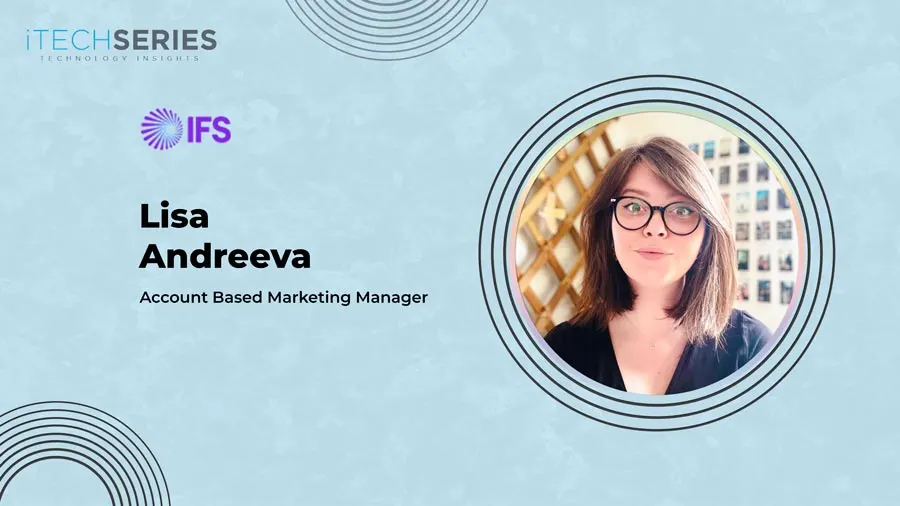
Lisa Andreeva, Account-Based Marketing Manager at IFS, shares how she builds ABM with strategic depth, human insight, and customer focus. In this conversation, she explores designing account-specific strategies, scaling ABM through a global Centre of Excellence, aligning teams around shared narratives, and using AI with judgement to drive meaningful, long-term account growth.
Welcome to the interview series, Lisa. Could you tell us more about yourself and your journey as a marketer?
Hello, and thank you for having me!
I’m Lisa, the Account-Based Marketing Manager at IFS, where I’ve built our ABM function and Centre of Excellence from the ground up. I lead the ABM strategy and enablement agenda for the company, shaping how account- and deal-based marketing operates across the organisation, while also owning end-to-end ABM strategy and execution for several global strategic accounts.
My marketing journey began a decade ago, moving from B2C events at a Weber Shandwick–affiliated PR agency into B2B tech. I started as a Field Marketing Specialist at Finastra (Misys at the time). After five years in the Field, in 2020, I transitioned into an ABM role at Finastra and co-founded the ABM function as part of a team of two.
And a little over two years ago, I joined IFS to build the ABM function here as well: creating the strategic framework, scaling best practices across regions and business units, and driving strategic account engagement for our most important customers and prospects.
What is your approach to designing account-specific strategies that effectively engage and convert high-value accounts?
For me, designing account-specific strategies always starts with strategic depth, not tactical boxes. High-value accounts rarely move because of activity; they move because you’ve understood and aligned with their priorities, their internal dynamics, and the human motivations behind their decisions.
This is what I am passionate about – the edge where strategy meets human insight. And ABM allows me to translate complex enterprise realities into clear, relevant, and deeply human narratives. I begin with a full account diagnosis: in-depth insights around commercial context, strategic priorities, transformation programmes, competitive pressures, executive mandates, and the narrative they believe about themselves.
From there, I ensure that marketing and sales are fully integrated into one successful mechanism. I partner closely with account teams to ensure we’re synchronised on goals, signals, and next steps. Then I built a strategic narrative for the account. Not “what we want to sell”, but “what they would like to buy and why it matters to them right now”. This narrative becomes the foundation for everything else: our value positioning, the plays we run, and the messages we tailor to executives, influencers, and operational teams.
Next comes orchestration and design. I build a multi-touch, multi-channel plan that aligns with where the account is in its journey. The plan always balances strategic impact with personal relevance: executive engagement, thought leadership, tailored experiences, internal advocacy building, and targeted digital activity all play a role, but only if they match the account’s actual reality.
All of the tactics need to answer questions: why, what for, and what’s next. So, lastly, of course, I report, analyse, evolve, and continue engagement to achieve agreed goals.
In what ways have AI-enabled tools shaped the execution and scaling of your ABM campaigns, and how do you ensure data quality and accuracy?
AI has become a daily go-to in my ABM work, but at the same time, I’m cautious about over-reliance. ABM fundamentally works because people buy from people, and that human connection, intuition, and emotional context cannot be automated.
Overusing AI risks stripping the work of the very humanity and nuance that make ABM effective in the first place. And I make sure that I remain very intentional about where and how I apply it, using AI for the tasks it’s genuinely good at to free up time and capacity for more creative and strategic work.
A good example is account research, which is a very well-known and highly labour-intensive and time-consuming part of ABM that also carries a real risk of inaccurate or unverified data. I’ve spent weeks developing and refining detailed prompts and then training an AI agent to pull information from multiple trusted sources, clearly label those sources, and structure insights so I can validate and challenge the output before using it. This ensures AI supports my work without introducing false confidence or shortcuts in judgement.
Ultimately, AI is only as effective as the thinking behind it. Using it well requires both training with the tools and sharpening our own judgement so we can apply it mindfully and protect the quality of the work.
How has marketing’s role evolved with greater collaboration between the sales, product, and customer success teams?
Marketing has evolved from being a delivery function to a connective one. As our collaboration with sales, product, and customer success has deepened, marketing has earned a seat at the “account-centric table”, where we can help define and evolve our relationship with accounts, translate insights, align narratives, and help teams move in the same direction.
In ABM, especially, this step in evolution is vital because it means alignment. Our target accounts experience a single brand, not separate teams, and we need to ensure seamless, consistent engagement with a credible narrative from every part of the business.
Ultimately, this has elevated marketing’s impact. When collaboration is strong, marketing becomes less about tactics and more about orchestration: aligning people, insight, and intent to build trust, relevance, and long-term value with customers.
“High-value accounts rarely move because of activity; they move because you’ve understood and aligned with their priorities, their internal dynamics, and the human motivations behind their decisions.”
How do regional and cultural considerations shape your ABM strategies?
At IFS, our ABM execution is firmly rooted in the regions, while I operate as part of a global team, leading ABM as a function through our Centre of Excellence. This global-to-regional balance is very intentional.
The Centre of Excellence provides the structure, frameworks, and strategic guardrails, but insight and direction come from the regions. Regional sales and marketing teams are closest to the accounts, markets, and cultural context, and their perspective directly informs how each account strategy is shaped. This ensures we avoid a one-size-fits-all approach and instead design strategies that genuinely reflect local realities.
This model works because it combines consistency with flexibility. We maintain a shared ABM language and quality standard globally, while allowing strategy and execution to adapt to what resonates locally. The result is ABM that feels relevant, respectful, and credible, not centrally imposed but co-created with the regions and shaped around the account.
What are some of the indicators beyond traditional KPIs that you look at to assess the real impact of a marketing initiative?
I pay close attention to sometimes subtle and very human indicators that signal real progress in relationships, perception, and momentum, especially in an ABM context where impact doesn’t always show up immediately in pipeline numbers.
For example, externally, I look for a shift in account perception. This can show up in qualitative feedback, the tone of conversations, openness to executive meetings, or an increased willingness to explore strategic topics rather than purely transactional ones. These are harder to quantify, but they’re critical in high-value, long-cycle accounts.
Internally, I look at alignment and confidence. Are account teams pulling marketing into strategic conversations earlier? Are different teams reusing marketing narratives and assets in customer discussions? When sales, marketing, and other stakeholders share a common view of the account strategy and feel confident in the story we’re telling, execution becomes more coherent and effective, and that almost always precedes measurable outcomes.
What has been your most challenging yet memorable experience as a marketer?
I suppose it’s building an ABM function from the ground up. And interestingly, I’ve done that twice.
The first time was at Finastra, where I was also transitioning from a field marketing role into the ABM team of two. That shift required a significant internal reset, moving from broad, activity-driven execution to a much more focused, account-centric way of thinking. At the same time, we were building the ABM function without an established blueprint while delivering results and serving mission-critical strategic customers.
The second time, at IFS, came with a very different challenge. While the goal was still ABM, the organisation, markets, and customer needs were not the same. Reinforcing that there is no single “right” way to build an ABM function. The approach, structure, and operating model had to be entirely different, shaped by the business context and the customers we serve.
What connected both experiences was a consistent principle: true customer centricity. In both cases, the most effective decisions came from distancing from the classic ABM best practice models, stepping away from templates, and asking how we could build ABM in a way that genuinely worked for the company and our customers (their strategies, challenges, and expectations), while still aligning internal teams around a shared direction.
Building an ABM function twice taught me that one size never fits all, but that when customer focus sits at the centre, the model, process, and execution naturally fall into place.
Looking back on your marketing journey so far, what’s the one key lesson you’d share with other marketers?
Looking back on my journey, the most important lesson I’d share is to stay focused on value.
As the boundaries between marketing, sales, product, and customer success continue to blur, the real question is no longer “who owns what?” but “what value are we creating?” and “why does it matter?”
Marketing’s value lies in its ability to connect the dots: to translate customer insight into clarity, align teams around a shared narrative, and help the business show up in a way that is relevant, credible, and human.
When marketing operates from a value mindset, it becomes a strategic enabler rather than a functional silo. It helps sales have better conversations, supports the product by grounding messaging in real customer needs, and reinforces customer success by ensuring continuity between what is promised and what is delivered.
In my experience, the most effective marketing isn’t the loudest or the most visible, but it’s the kind that creates focus, builds trust, and makes it easier for customers to say “yes” at every stage of the journey. Focusing on value is what keeps marketing relevant as roles evolve and what ultimately makes the work matter.
About Lisa Andreeva
Lisa Andreeva is an Account-Based Marketing Manager at IFS with over 10 years of B2B marketing experience. She specialises in customer-centric demand generation, strategic account engagement, and pipeline acceleration. Lisa combines creativity, data-driven insights, and cross-functional collaboration to design high-impact ABM strategies, scale global programs, and drive meaningful results for strategic accounts, continuously shaping marketing’s role as a strategic enabler.