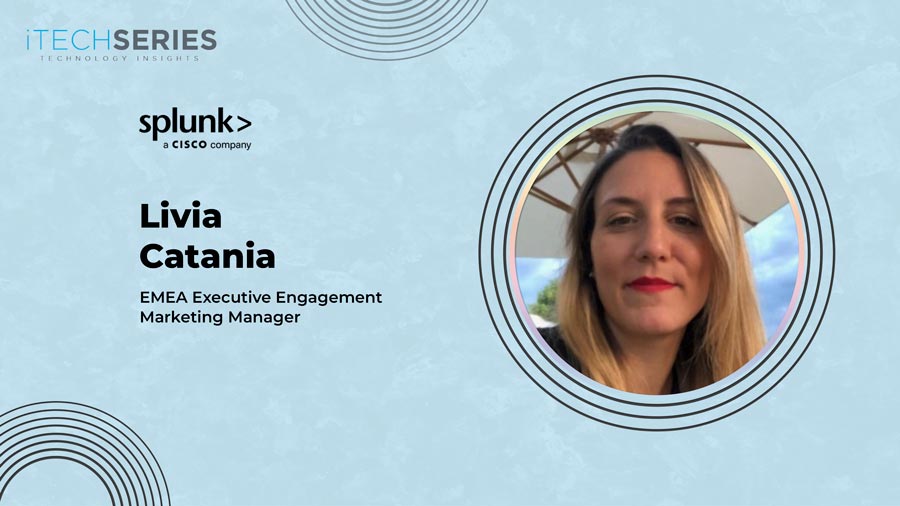
Livia Catania, an executive engagement marketing manager with experience across EMEA, shares her journey from law and journalism to designing high-impact CxO programs. In this interview, she explores how trust, cultural nuance, and outcome-driven engagement help brands earn relevance, respect executive time, and build lasting C-suite relationships.
Welcome to the interview series, Livia. Could you tell us more about yourself and your journey as a marketer?
My path into marketing has taken a bit of a scenic route. When I was completing my education, back when graduation photos were captured on actual film (smartphones weren’t a thing yet), marketing wasn’t actually the destination I had in mind. I first graduated in Law and then pursued a Master’s in Journalism and New Media, fully expecting my career to follow those paths.
However, I’ve found this ‘unplanned’ start to be a significant advantage in such a dynamic field. My legal studies taught me how to extract critical information and master the art of synthesis, while journalism gave me the tools to read political and business landscapes.
Before transitioning into my current focus on executive engagement, I spent several formative years working at the heart of leadership teams for C-suite executives across very different landscapes, from the public sector in Italy and private equity in London to the travel tech industry.
These diverse experiences, before fully moving into the tech sector, shifted my focus from ‘what we want to say’ as a brand to ‘what leaders actually need to hear.’ Today, my goal is to bridge the gap between high-level business strategy and authentic relationship building.
How did you design the EMEA Field CxO program to stay relevant for senior executives, and what were the key challenges in scaling it while keeping a premium experience?
The design of the EMEA Field CxO program centered on elevating our engagement to a strategic partnership model. Working closely with our team of Chief Technical Advisors, we focused on building change agendas that bridge the gap between complex business challenges and IT solutions. To ensure relevance, I prioritised activities offering genuine peer-to-peer value and a strong personal connection, ensuring our conversations are always aligned with high-level business outcomes.
Scaling this while maintaining a premium, ‘white-glove’ experience involved a significant amount of heavy lifting. The goal was to create a standardised framework for our programs across EMEA to ensure consistent excellence, while still leaving room for the regional flavor that makes an engagement feel personal and locally relevant. By building this robust structure and aligning our cross-functional teams, we were able to ensure that the quality of engagement remained world-class, regardless of the territory or the specific local rules of engagement.
What are the most common mistakes you see brands make when trying to engage senior decision-makers?
The most frequent mistake is failing to respect an executive’s time. In the C-suite, time is the most precious currency, and respecting it goes far beyond just keeping a meeting short; it’s about the density of value you provide in those minutes.
Too often, brands ask leaders to sit through generic discovery calls or product-heavy pitches where the executive ends up doing the heavy lifting of educating the vendor. True respect for their time means doing the homework upfront. It means leading with a clear point of view on their specific business outcomes and industry macro-challenges, rather than expecting them to find the relevance in your features. If an executive leaves a meeting feeling like they’ve learned something new about their own landscape, you’ve respected their time.
Brands often lead with product features rather than business outcomes. Senior leaders aren’t looking for a vendor; they are looking for a long-term, trusted partner who understands their industry’s macro challenges. Another mistake is “one-and-done” engagement. Executive marketing is a long game; if you don’t have a sophisticated follow-up strategy to nurture that relationship, the initial investment is wasted.
Another common pitfall is overlooking the human side of the experience. Especially for physical events, we must think with empathy about every small detail that makes the experience smoother and more pleasant for an executive. From the moment they arrive to the moment they leave, the goal should be a seamless, high-value journey. My philosophy is to constantly raise the bar for every single engagement and never settle for good enough when you are dealing with the C-suite.
How does executive engagement differ across EMEA, and what should global teams be more mindful of?
EMEA is absolutely not a monolith, and having personally navigated the move from Rome to London, I’ve experienced firsthand that a cultural shift is about much more than just a change in geography; it’s a change in the ‘business language’ of trust.
In Southern Europe, for example, executive engagement is often deeply rooted in long-term relationship building and personal connection; trust is the prerequisite for the business conversation. In contrast, Northern European or UK markets often prioritise efficiency, directness, and immediate value-addition. Having lived and worked in both environments, I’ve learned that if you try to apply a ‘one-size-fits-all’ model, you risk being seen as tone-deaf.
Global teams should be mindful that localisation isn’t just about translating a slide deck into another language; it’s about translating the approach. You have to understand the local business etiquette, the social norms, and the market maturity. My own journey of adapting to a new culture has made me a passionate advocate for this: you must meet executives where they are, both culturally and professionally.
“Brands often lead with product features rather than business outcomes… Senior leaders aren’t looking for a vendor; they are looking for a long-term, trusted partner.”
When running global campaigns, how do you make sure the brand stays consistent while still feeling locally relevant?
It’s about “Global Vision, Local Execution.” You must ensure that the core brand pillars and messaging are intact, but empower the regional teams to adapt the flavor. This might mean changing the format of an event or the specific industry use cases we highlight. By maintaining a consistent visual, messaging, and strategic identity but tailoring the delivery, we ensure the brand feels like a local partner with a global scale.
Could you tell us about your most memorable experience as a marketer?
If you want to test a marketer’s logistical limits, ask them to organize a high-end event for 100 C-level executives in Venice and then do it solo while eight months pregnant! Venice is a logistical puzzle where everything moves by boat and over bridges. The adventure peaked when our water taxi, loaded with event materials, was pulled over by the Carabinieri (Italian Police) for a random check. Picture me, eight months pregnant, negotiating with the police in the middle of a canal! Managing that event completely alone taught me that with enough planning and a positive mindset, you can pull off the impossible. After that, no marketing challenge feels too big!
How do you track ROI for executive-focused programs where influence matters as much as pipeline?
We look at a balance of both ‘hard’ and ‘soft’ metrics. On the hard side, we track traditional indicators like pipeline generation and conversion rates. However, for the C-suite, influence is often the more critical metric.
To measure this, we look at factors like executive attendance retention, seeing if leaders return to our programs year after year, and ‘deal velocity’ within those specific accounts. If an executive engagement program helps shorten the sales cycle for a complex, high-value deal, that influence is just as measurable and impactful as a direct lead. Ultimately, it’s about proving that marketing isn’t just a cost center, but a strategic driver of the business.
What is the single most important piece of advice you would give to a marketer starting their career?
My biggest piece of advice is to be curious about the business, not just the marketing. You need to grasp the commercial realities of your organisation and the strategic pressures that shape your customers’ decision-making. When you align your work with these broader goals, your role shifts from executing campaigns to becoming a strategic partner and a genuine driver of growth for the business.
Beyond the strategy and the data, use empathy to truly step into the shoes of the executives you are serving, understanding their pressures and their world. In high-level engagement, trust is the only currency that matters. Marketing is a team sport, and building strong, cross-functional relationships based on integrity is what allows you to get things done.
Finally, always strive to be the person your customers trust and look forward to seeing at every engagement. If you treat every interaction with genuine care and professional excellence, you aren’t just building a brand, you’re building a lasting relationship.
About Livia Catania
Livia Catania is a tech marketing leader specialising in executive engagement across EMEA, helping global brands connect with C-suite decision-makers through strategic storytelling and tailored, high-impact experiences. With a background in law and journalism, she brings sharp analytical thinking and cultural insight to boardroom conversations. Having worked closely with senior leaders across the public sector, private equity, and travel tech, Livia focuses on translating complex technology into meaningful business outcomes built on trust.