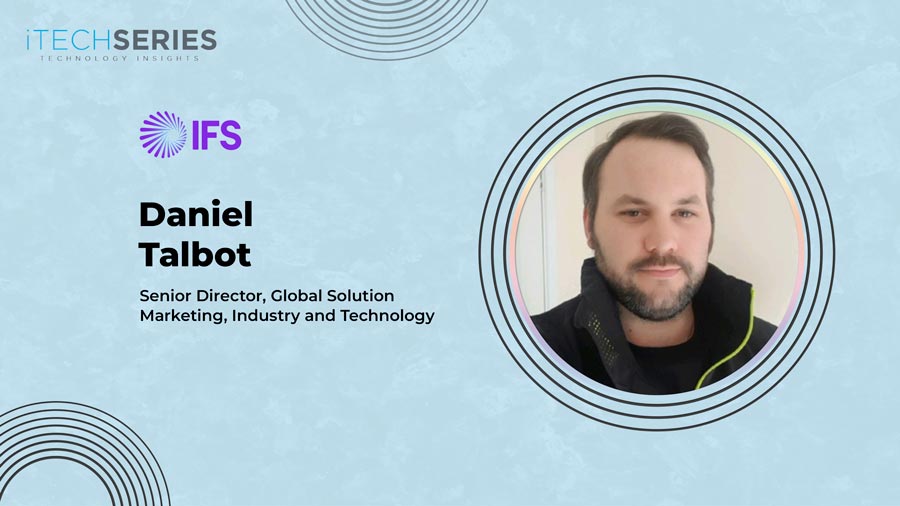
Daniel Talbot, Senior Director of Global Solution Marketing, Industry and Technology at IFS, shares his journey from marketing insight and analytics to global leadership. He explores how marketing is becoming a strategic growth driver, the role of ABM, customer-centric insights, global-local relevance, and the connection between innovation and tangible business outcomes.
Welcome to the interview series, Daniel Talbot. Could you tell us about yourself and your journey as a marketer?
So, a little bit about me: I’m a proud family man, and I’m supported by an amazing wife and two incredible young children. Outside of work, my main passions are motor racing, gardening, and making as many memories as I can with my family.
My marketing journey has been anything but planned, which is probably why I’ve enjoyed it so much. I originally studied Economics, finance, and International Business at Oxford Brookes University, and during a placement year I found myself working in marketing. What started as a temporary opportunity quickly became a passion. I discovered that marketing sits at the intersection of creativity, psychology, data, and commercial strategy, and that’s a combination I’ve always been drawn to.
I began my career in the world of marketing services and insight, spending several years helping B2B organisations understand their customers, optimise campaigns, and turn data into meaningful business outcomes. That foundation in CRM, analytics, and customer insight taught me an important lesson early on: outstanding marketing isn’t about creating noise; it’s about understanding people and delivering value.
From there, I moved into the enterprise software industry, taking on marketing leadership roles at DSI before joining IFS in 2021. Since then, I’ve had the opportunity to progress through several roles spanning industry marketing, account-based marketing, and solution marketing, culminating in my current role as Senior Director of Global Solution Marketing, Industry and Technology.
Looking back, I’ve gone from building reports and analysing databases as a placement student to leading global marketing programmes and teams. It’s been an incredible journey, but what still excites me most is the same thing that got me hooked on marketing in the first place: understanding an audience, telling a compelling story, and creating something that genuinely makes an impact.
Where do you see the biggest shift in the role of marketing within today’s go-to-market strategy?
The biggest shift is that marketing has evolved from a demand generation function into a strategic growth driver.
Today’s buyers are more informed and engage with vendors much later in the buying journey, which means marketing can no longer focus solely on generating leads. Instead, we play a critical role in shaping market narratives, identifying growth opportunities, aligning sales and product teams, and driving revenue outcomes across the entire customer lifecycle.
At the same time, AI and data are enabling greater precision and personalization, but the fundamentals remain the same: understanding your audience, telling compelling stories, and creating meaningful customer value.
Ultimately, the most successful organisations no longer see marketing as a support function. They see it as a strategic partner that helps define and execute the go-to-market strategy.
How do you uncover the customer insights that make industry marketing campaigns more relevant and effective?
It starts with listening. The best insights come from combining customer conversations, sales feedback, industry trends, analyst research, and campaign data to understand not just what customers are buying, but why. In industry marketing, every sector has unique challenges and priorities. By understanding those realities and focusing on the business outcomes customers want to achieve, we can create messaging and campaigns that feel far more relevant and impactful. Ultimately, the most effective campaigns are built around customer problems and desired outcomes, not products.
What separates ABM programs that drive real business outcomes from those that simply generate activity?
The difference is focus and alignment. Successful ABM programs are built around a clear set of target accounts, shared goals with sales, and metrics tied to pipeline and revenue, not just engagement. It’s not about reaching more people; it’s about reaching the right people with the right message at the right time. Ultimately, the best ABM programs are measured by business impact, not marketing activity. They create meaningful engagement with key stakeholders, strengthen sales and marketing collaboration, and contribute directly to sustainable revenue growth and stronger customer relationships.
“The biggest shift is that marketing has evolved from a demand generation function into a strategic growth driver.”
Can you share one of your most impactful or memorable marketing campaign experiences?
So in my career I’ve had the opportunity to lead some really amazing marketing campaigns but also be part of a team working towards a common end goal. I think it’s also really important to distinguish between impactful vs. memorable; I would say these two are very different things.
However, handed to the fire, and I have to pick one moment, I would pick the one moment that completely changed my mindset as a marketer: the first time one of my campaigns didn’t get a positive ROI… At the time, I was in my early 20s, and I’d followed the rulebook. I’d let data drive the strategy direction, worked with an amazing award-winning creative agency, had complete alignment between sales, business development, and marketing, and so on.
However, after running the program for 14 months out of a planned 24, I had to make the decision to pull the plug. At the time, I couldn’t get my head around why it had not performed as well as I anticipated. I spent so many evenings analyzing every component of the campaign: each digital channel and tactic, the Direct Mail and experiential components, the overarching campaign message, and so on.
Why this has been so memorable is that it was the first time it made me realize marketing is not a vending machine; just because you put X in doesn’t mean you will get Y out, and acting decisively is key. That decision to pull the campaign early freed up budget; when posed with the question of what we should use it to do instead, I suggested an event that turned out to be the year’s most successful. Essentially, having the confidence to know when to stop.
You’ve developed marketing strategies across multiple industries and regions. How do you balance global consistency with the need for local market relevance?
I believe the key is to standardize the what and localize the how.
The core value proposition, messaging framework, and brand story should remain consistent globally, ensuring customers have a clear and unified view of who you are. However, the way those messages are delivered should reflect local market dynamics, industry priorities, cultural nuances, and customer challenges.
The most effective approach is to provide regional teams with a strong strategic foundation while giving them the flexibility to adapt content and campaigns for their audience. That balance allows you to maintain global consistency without sacrificing local relevance.
Ultimately, the goal is for customers to hear the same story, but in a way that feels tailored to their market and business needs.
How do you ensure marketing campaigns communicate both technical innovation and tangible business value to enterprise customers?
The key is to start with the business outcome, not the technology.
Enterprise buyers care about innovation, but they’re ultimately investing to solve a problem, reduce risk, improve efficiency, or drive growth. Our role is to translate technical capabilities into tangible business value by showing how the technology impacts the metrics that matter to them.
I often say that customers buy outcomes, not features. The most effective campaigns combine a clear explanation of the innovation with real-world examples of how it helps organisations achieve their goals. When you connect technology to business impact, the story becomes much more compelling.
About Daniel Talbot
Daniel Talbot is an experienced B2B marketing leader with expertise in industry marketing, account-based marketing, customer insight, solution marketing, CRM, analytics, and campaign strategy. His career spans marketing services and enterprise software, where he has helped organisations understand customers, develop relevant campaigns, and drive meaningful business outcomes. Daniel is passionate about combining customer understanding, data-driven decision-making, and strategic thinking to create marketing programs that deliver measurable business impact.