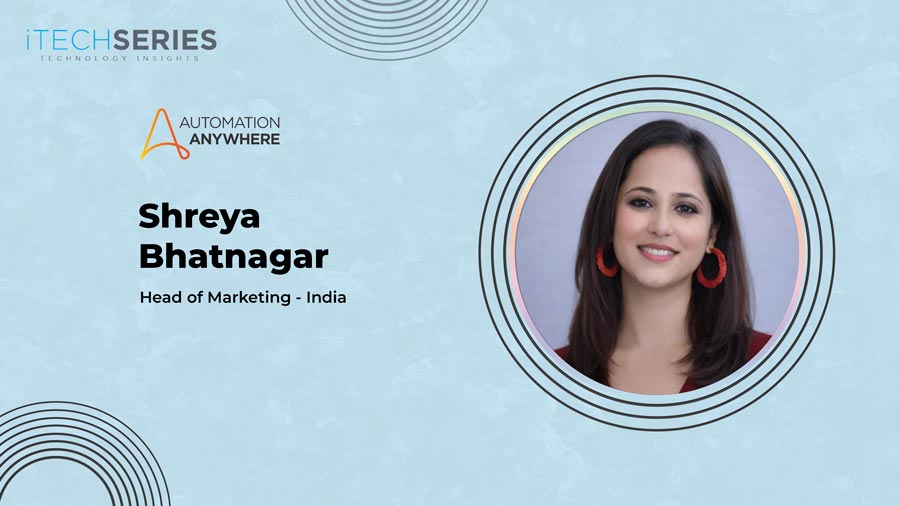
Shreya Bhatnagar, Head of Marketing – India at Automation Anywhere, shares insights on the evolving role of enterprise marketing across AI, customer advocacy, revenue alignment, and digital transformation. She discusses building trust at scale, creating meaningful customer experiences, leveraging AI responsibly, and how modern marketers can drive long-term business impact through strategic influence and ecosystem-led growth.
Shreya, it’s great to have you on this interview. Could you tell us about your marketing journey so far?
My marketing journey has been a blend of building brands, driving strategic conversations, and creating experiences that deliver measurable business impact. Over the years, I’ve worked extensively at the intersection of enterprise technology, storytelling, and executive engagement, especially across AI, automation, and digital transformation.
A large part of my work has involved shaping high-impact initiatives and industry platforms that bring together CXOs, customers, analysts, and partners. I enjoy taking complex technology narratives and translating them into conversations that are relevant, outcome-driven, and commercially meaningful.
What excites me most about marketing today is that it’s no longer just about visibility—it’s about influence, credibility, and creating real business momentum. That’s the space I’ve consistently tried to operate in.
How has marketing’s role evolved with closer alignment between the different revenue functions?
Marketing today is far more integrated with revenue than it was a few years ago. Earlier, marketing was often measured by visibility and lead volume. Now, it’s expected to directly influence pipeline, customer expansion, partner growth, and overall business outcomes.
The biggest shift has been the alignment between marketing, sales, customer success, alliances, and leadership teams. Campaigns are no longer built in silos—they’re designed around shared revenue goals, customer journeys, and account priorities.
This has also changed the kind of marketer organizations need. Modern marketing requires stronger business understanding, closer collaboration with sales, sharper data-driven decision-making, and the ability to create experiences that move customers through the funnel faster.
In many ways, marketing has evolved from being a support function to becoming a strategic growth driver.
What strategies have you found most effective for turning customers into advocates and strengthening brand recognition?
I believe customer advocacy is fundamentally built on trust, relevance, and shared value creation. The most effective brands today are not the ones speaking the loudest—they’re the ones enabling customers to become part of the narrative itself.
One strategy that has consistently worked is shifting from transactional engagement to ecosystem thinking. Instead of treating customers as endpoints in the funnel, we involve them as collaborators in industry conversations, innovation stories, peer learning, and leadership communities. That changes the nature of the relationship entirely: from vendor-customer to strategic partnership.
Another critical factor is creating moments of professional value for the customer, not just commercial value for the company. When a platform elevates a customer’s leadership positioning, showcases their transformation journey, or helps them influence peers within the industry, advocacy becomes far more organic and enduring.
I also think brand recognition today is deeply tied to credibility. In enterprise marketing, especially, audiences trust lived experiences over polished messaging. That’s why customer-led storytelling, peer validation, and community influence often outperform even the most sophisticated brand campaigns.
At a broader level, the role of marketing has evolved from broadcasting narratives to architecting trust at scale, and customer advocacy sits at the centre of that evolution.
What’s your approach to allocating marketing budgets and measuring success to ensure the biggest gains in new pipeline and customer acquisition?
My approach to marketing budgets has always been anchored in business outcomes rather than channel allocation. I think the more important question is not “How much are we spending?” but “Where does marketing create the highest compounding impact across the revenue cycle?”
I typically look at investments across three layers: demand creation, pipeline acceleration, and long-term brand equity. While performance-led initiatives drive immediate acquisition, brand and community-led investments often improve conversion efficiency, deal velocity, and customer trust over time. The strongest marketing strategies balance both short-term pipeline goals and long-term market positioning.
I also believe budget allocation should closely mirror business priorities. For example, strategic accounts, expansion markets, partner ecosystems, or emerging solution areas may deserve disproportionate investment if they align with future growth opportunities.
In terms of measurement, I prefer moving beyond vanity metrics and even beyond isolated lead metrics. The more meaningful indicators today are pipeline influence, account progression, conversion quality, customer acquisition cost efficiency, deal acceleration, and ultimately revenue contribution.
Equally important is understanding attribution more holistically. In enterprise marketing, decisions are rarely driven by a single touchpoint. Brand perception, executive engagement, peer influence, events, analyst credibility, and digital experiences all compound over time. The challenge and opportunity is building a measurement framework that captures marketing’s cumulative impact on revenue, not just its last-click contribution.
“At a broader level, the role of marketing has evolved from broadcasting narratives to architecting trust at scale, and customer advocacy sits at the centre of that evolution.”
How do you tailor marketing strategies for complex technology stacks like multi-cloud, end-user computing, and cybersecurity solutions?
Marketing complex technology solutions requires a very different mindset from conventional product marketing. With areas like multi-cloud, cybersecurity, or end-user computing, buyers are navigating technical complexity, operational risk, budget scrutiny, and long decision cycles simultaneously. So the role of marketing becomes less about simplification and more about contextualization.
My approach is first to understand the business tension behind the technology decision. For instance, a CIO may think about scalability and resilience, and a CISO about risk exposure and governance, while business leaders focus on agility, productivity, and ROI. The messaging, therefore, cannot be one-dimensional; it has to translate the same technology narrative into different strategic outcomes for different stakeholders.
I also believe that enterprise technology marketing works best when it moves from feature-centric storytelling to architecture-centric storytelling. Customers are rarely buying isolated tools anymore; they are evaluating interoperability, ecosystem compatibility, security implications, and long-term transformation value. Marketing has to reflect that level of sophistication.
Another important aspect is credibility. In highly technical categories, trust is built through practitioner-led conversations, customer proof points, analyst validation, and domain expertise, not just campaigns. That’s why thought leadership, peer communities, solution workshops, and customer-led discussions become far more influential than traditional top-of-funnel marketing.
Ultimately, the goal is to make complex technology feel strategically inevitable rather than technically intimidating.
Could you tell us about your most fulfilling marketing campaign experience?
One of the most fulfilling experiences for me has been building executive-level industry platforms that brought together customers, partners, analysts, and business leaders around emerging technologies like AI and automation. The AI-Gurukul!
What made the experience especially meaningful was that it went far beyond event marketing or demand generation. The objective was to create a credible industry conversation, one where customers could openly discuss transformation journeys, operational challenges, governance concerns, and measurable business outcomes.
From a marketing standpoint, it required aligning multiple dimensions simultaneously: strategic messaging, executive engagement, customer advocacy, partner collaboration, analyst relations, pipeline creation, and brand positioning. The complexity of orchestrating all of those moving parts while still delivering commercial impact was incredibly rewarding.
What stayed with me most, however, was seeing customers evolve from attendees into advocates and contributors. When customers voluntarily share their stories, bring peers into the ecosystem, and begin associating your platform with industry leadership, that’s when you realize marketing has moved beyond promotion into influence and community-building.
For me, the most fulfilling campaigns are always the ones that create lasting strategic relationships, not just short-term visibility.
How do you leverage the power of AI-enabled tools to guide your marketing efforts without being too reliant on them?
I see AI as a force multiplier for marketing, not a substitute for strategic thinking. The real value of AI-enabled tools lies in their ability to accelerate analysis, surface patterns, personalize engagement at scale, and improve operational efficiency, but the direction, judgment, and narrative still need to come from humans.
I use AI extensively for areas like audience intelligence, campaign optimization, content structuring, trend analysis, and extracting actionable insights from large volumes of data. It significantly improves speed and decision-making efficiency, especially in fast-moving enterprise environments.
At the same time, I think there’s a real risk in becoming overly dependent on AI-generated outputs without applying human context. Marketing ultimately operates in areas like trust, emotion, cultural nuance, and business judgment, things AI can support, but not fully replicate.
What’s important is maintaining a balance between automation and originality. AI can help scale execution, but differentiation still comes from human insight, creativity, and the ability to understand what truly matters to customers and markets.
In many ways, I believe the future of marketing will belong to teams that know how to combine AI-driven intelligence with a distinctly human perspective.
How do you foresee the role of marketing evolving in the context of enterprise technology, partner ecosystems, and customer experience in the next 3–5 years?
Over the next 3–5 years, I believe marketing in enterprise technology will evolve from a function focused on awareness and demand generation into one that actively shapes business ecosystems, customer trust, and strategic influence.
One major shift will be the growing convergence between marketing, customer experience, and revenue functions. Enterprise buyers today interact with brands across multiple touchpoints, communities, partners, analysts, peer networks, events, digital platforms, and customer stories. As a result, marketing will increasingly become the orchestrator of the entire customer perception journey, not just the top of the funnel.
I also see partner ecosystems becoming far more central to marketing strategy. With technologies becoming more interconnected across AI, cloud, cybersecurity, automation, and data platforms, no company operates in isolation anymore. The strongest brands will be the ones that can co-create value with partners, customers, and industry communities rather than simply market standalone solutions.
Another important evolution will be around credibility. As AI-generated content becomes more widespread, authentic expertise and trusted relationships will become even more valuable differentiators. Customer advocacy, peer-led influence, executive communities, and practitioner-driven storytelling will likely carry more weight than conventional brand messaging.
At the same time, marketing itself will become far more intelligence-driven. AI will reshape how teams understand buying intent, personalize engagement, predict customer behavior, and optimize decision-making. But I don’t think this will reduce the human element; if anything, it will elevate the importance of strategic thinking, creativity, and emotional intelligence.
Ultimately, I think the future enterprise marketer will need to operate less like a campaign manager and more like a business strategist, ecosystem builder, and trust architect.
About Shreya Bhatnagar
Shreya Bhatnagar is a passionate marketing leader with 12 years of experience in customer advocacy, demand generation, ABM, and revenue growth across high-growth technology markets. With expertise in market strategy and strategic content development, she collaborates closely with sales and global teams to drive pipeline growth, enterprise engagement, and brand recognition. She has consistently delivered strong business impact through high-touch marketing programs, data-driven strategies, and effective brand management initiatives.