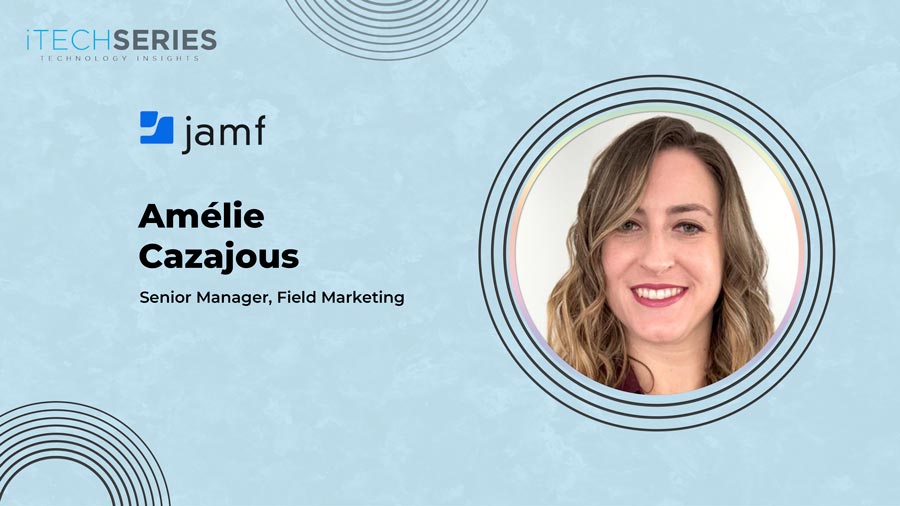
In this interview, Amélie Cazajous, Senior Manager, Field Marketing at Jamf, shares insights from 15+ years in global B2B marketing across industries and regions. She discusses balancing global strategy with local execution, driving revenue-focused demand generation, aligning cross-functional teams, and leveraging AI. Her journey highlights modern marketing leadership built on integration, adaptability, and customer-centric growth.
Welcome to the interview series, Amélie. Could you tell us about yourself and your journey as a marketer?
My marketing journey started over 15 years ago, and what strikes me most is how much ground it has covered across industries, disciplines, and geographies. I’ve had the privilege of working within large global organisations and multicultural environments, and that international dimension has been central to my career from early on.
I’ve led marketing at both a country level, with dedicated responsibility for markets like the UK, France, Spain, and Germany, and at a broader regional level, overseeing the full EMEIA region. That combination has been incredibly formative. Working within a single market teaches you to go deep: local nuances, buyer behaviours, and cultural context. Stepping up to a regional remit challenges you to find the balance between consistency and localisation, recognising where commonalities exist and where a one-size-fits-all approach simply won’t work.
Early in my career, I also got my hands dirty across almost every dimension of marketing: events, digital, advertising, PR, content, and more. That breadth turned out to be invaluable. When you’ve lived inside each discipline, you stop thinking about them as separate channels and start seeing how they reinforce each other in integrated campaigns. Over time, my role has evolved from execution to strategy and team leadership, but having been in the deep end early on makes me a better strategic thinker today.
How do you adapt global marketing strategies to diverse regional markets while maintaining consistency and impact?
It really comes down to one word: balance. On one side, you have the company direction, the overarching goals, core messaging, and brand identity, which must remain consistent to build recognition and trust at scale. On the other hand, you have the reality of markets that differ not just in language but also in culture, buying behavior, and how people expect to engage with a brand.
The skill lies in knowing where to hold firm and where to flex. Sometimes it’s about nuancing the main message for a specific market. Other times, entire value propositions need to be brought to the foreground locally. And some things simply don’t translate, in the broadest sense. A campaign mechanic or cultural reference that lands perfectly in one country can fall flat in another. Beyond messaging, this extends to the activities you run and how you show up in person.
None of this is possible without genuinely knowing your markets, through research, customer relationships, time in the field, and actively seeking feedback. That said, reinventing the wheel for every market is neither scalable nor smart. The goal is a strong, flexible framework that gives local teams the foundation to adapt with confidence, without starting from scratch every time.
Can you walk us through a demand generation campaign that significantly impacted the pipeline or revenue?
Demand generation and net new pipeline are absolutely essential; no business grows without bringing new customers through the door. But some of the most impactful revenue moments I’ve been part of have come from investing just as deliberately in the customers we already have. The two are more connected than people often realise.
At Jamf, community is genuinely at the heart of how we go to market. We’ve built an ecosystem of customer-facing experiences, from large-scale gatherings that bring customers and partners together for content, peer roundtables, and hands-on conversations, to intimate curated formats for targeted accounts with specific growth opportunities. The larger events have evolved significantly: they’re environments where customers exchange real-world insights and where one-to-few conversations happen that no digital campaign could replicate. The peer-to-peer dynamic builds trust in a way brand messaging alone never will.
The format I’m most excited about is the smaller, high-touch executive experience. Throughout my career, I’ve seen these initiatives deliver results that are genuinely hard to achieve any other way: reducing churn, guiding customers towards better-fit solutions, and driving the deep adoption that creates long-term stickiness. Customers don’t just renew; they expand, advocate, and attract the next generation of customers.
Retention is revenue. Expansion is revenue. And a loyal advocate is worth more than almost any lead from a paid campaign.
“Field marketing has grown from a delivery function into a strategic revenue contributor; the playbook and the conversations have changed.”
How do you ensure strong alignment between Marketing, Sales, Product, and RevOps when priorities compete?
The short answer: together, we are always stronger. But getting there requires deliberate, consistent effort, especially when priorities don’t naturally align.
The foundation is relationship-building. Alignment isn’t achieved in a single planning meeting; it’s cultivated over time through trust, transparency, and genuine listening. When your counterparts in Sales, Product, and RevOps know you understand their challenges and won’t advocate for marketing at the expense of the bigger picture, you stop being competing functions and start being a team.
That shared outcome is everything. Friction between teams rarely comes from bad intentions; it comes from misaligned priorities. Each function can be doing excellent work in isolation and still pulling in different directions. Regularly coming back to company goals, reviewing metrics, priorities, and resource needs together, openly and honestly, prevents the kind of misalignment that only surfaces when it’s already causing damage.
The other essential piece is genuine buy-in. The best strategy in the world fails without it. Buy-in means people understand the why, feel heard, and are invested in the outcome. That’s what turns alignment on paper into real, coordinated momentum.
How has field marketing evolved in today’s revenue-driven and integrated go-to-market environment?
Field marketing has undergone a significant transformation, and it’s one of the evolutions I find most exciting to be part of.
For a long time, field marketing was seen primarily as an execution function. Success was measured by attendance numbers, delegate satisfaction scores, and open rates. Those things still matter; a poorly executed event reflects badly on the brand, but they are no longer sufficient on their own.
Today, field marketing sits at the centre of pipeline generation and revenue growth. The most important shift is the depth of integration with revenue teams. Field marketing now works hand in hand with sales, demand generation, and RevOps, combining expertise to identify the right activities, audiences, and moments in the buying journey. Sales knows the accounts and objections; marketing knows the audience and channels. When those two worlds truly collaborate, you get activities far more targeted and impactful than either could produce alone.
This integration also brings a harder conversation to the surface: alignment on what success actually looks like. An event team can deliver a flawless experience and still miss the mark if the right accounts weren’t in the room or there was no follow-through. Marketing-sourced pipeline and opportunity creation must be agreed upon upfront, not evaluated after the fact. Field marketing has grown from a delivery function into a strategic revenue contributor; the playbook and the conversations have changed. What hasn’t changed is the importance of human connection, which is ultimately what field marketing has always been about.
What’s your approach to leading and aligning high-performing, multicultural marketing teams across regions?
Leading a multicultural, geographically dispersed team is one of the most rewarding and genuinely complex aspects of my role. My approach starts with a simple belief: great teams are built on great communication, and that starts with understanding that not everyone thinks, works, or communicates the same way.
I invest real time in understanding the people on my team, their backgrounds, working styles, and cultural frames of reference. Tools like the Myers-Briggs test and Erin Meyer’s book, The Culture Map, have been genuinely eye-opening in helping me appreciate why someone might approach a challenge very differently from how I would. That awareness makes the whole team more effective; we stop misreading each other and start leveraging our differences as a strength.
Communication is everything. That means being transparent and consistent but also adaptive, adjusting how I communicate depending on who I’m speaking to. It means taking the time to ask, listen, and check understanding rather than assuming alignment. And it means always providing context: a decision without the background behind it can feel arbitrary or demotivating.
Ultimately, aligning a diverse team isn’t about making everyone work the same way. It’s about building enough shared clarity on goals, ways of working, and mutual respect that the differences become an advantage rather than a friction point.
How have AI and automation reshaped your approach to campaign execution and customer engagement?
AI has genuinely changed the way my team works, and the pace of that change has been remarkable. What started as curiosity has become something more fundamental: a shift in how we approach almost every project and challenge.
The question we now ask at the start of any initiative isn’t just “what do we need to do?”; it’s “how can AI help us do this better, faster, or further?” In practice, AI has become a genuine thinking partner: for brainstorming, content creation and review, localisation across our EMEIA markets, optimising digital flows, and streamlining processes that used to consume disproportionate time. The ability to personalise at scale, test more, and make smarter decisions about where to focus has been transformative.
We are still at the beginning of this journey, but the direction is clear. For any marketer who feels daunted, my advice is simple: carve out regular time to use AI and make it a habit. Start with one small task. Share what you discover with colleagues. Before long, you’ll find yourself reaching for it instinctively.
The teams that will pull ahead won’t be the ones with the biggest budgets or the most sophisticated tech stacks. They’ll be the ones that think most intelligently about how to use AI, transforming insight into impact, speed into scale, and intelligence into measurable growth. That’s the mindset I try to bring to my team every day.
About Amélie Cazajous
Amélie Cazajous is a Strategic Marketing Leader with 15+ years of experience driving growth across EMEA and international markets. She currently leads Field Marketing at Jamf, aligning regional demand generation with global objectives and partnering with Sales to deliver revenue impact. Her expertise spans demand generation, field marketing, brand strategy, and digital performance. She has managed large-scale events, built multilingual teams, and focuses on data-driven, people-first leadership that turns marketing into a growth engine.