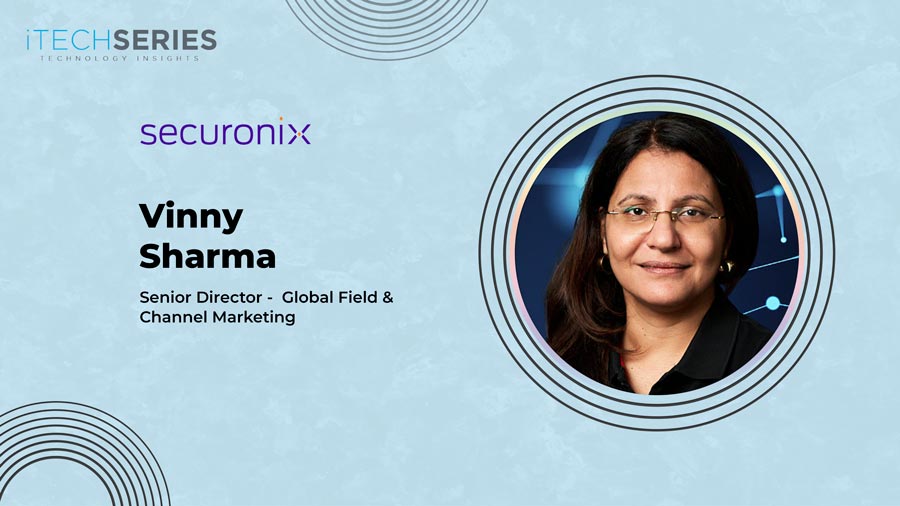
In this exclusive interview, Vinny Sharma, Senior Director – Global Field & Channel Marketing at Securonix, shares her unconventional journey from commerce graduate to cybersecurity marketing strategist. She discusses building marketing functions from scratch, driving cross-functional alignment, leveraging AI for smarter decisions, and creating customer-centric platforms like Securonix SPARK, offering insights into strategy, leadership, and measurable business impact.
Welcome to the interview series, Vinny. Could you tell us more about yourself and your journey as a marketer?
Unlike many others in the space, I did not follow the conventional path for my journey in technology marketing. After my graduation in commerce, I opted for a foundational technology program before pursuing an MBA in marketing. Media and customer-facing experiences during my earlier days sharpened my understanding of communications, influencers, and customer behaviors. My first job in tech marketing was with a global networking company when the function was still in its nascent stage in India, which was mostly event-driven. There, I saw the possibility of converting it into a strategic business enabler. With a thorough understanding of sales dynamics and customers’ changing perceptions, risk evaluation, and technology in shaping business outcomes, I transitioned from executive-focused responsibilities into a strategic leadership role. After building the marketing function from scratch as the first hire in Marketing for the Securonix Asia Pacific region, I soon assumed global responsibilities. I gained an understanding of cultural nuances and regional cybersecurity maturity after working across the Americas, Europe, and Asia. Throughout this journey, my key focus remained consistent, driving pipeline generation and management, empowering sales, and ensuring marketing solved real-world challenges faced by customers across industry verticals.
When launching go-to-market strategies across regions, what signals strong cross-functional alignment?
Strong cross-functional alignment is evident when strategy, execution, and business outcomes are seamlessly connected, enabling teams across sales, marketing, product, and operations to work toward shared goals with clarity and accountability. Marketing is not only about brand messaging and promotion, but also about the shared outcomes of other business units working closely together to establish what can be achieved and the path to take to achieve it. It is important for the marketing teams to work closely with the sales teams to develop customized go-to-market strategies, enhancing sales enablement and driving account-based marketing initiatives. A deep understanding of the common goals of Product, Sales, Marketing, and Customer Experience, along with a comprehensive plan for achieving them, is crucial. Furthermore, these goals should be measurable, where conversion rates are improved and sales cycles shortened, in addition to being time-bound. Fostering strategic partnerships with key channel partners, alliances, and resellers, and driving co-marketing initiatives and joint pipeline-building activities are equally critical.
In a crowded cybersecurity market, how do you differentiate your brand and drive sustainable regional expansion?
Being named a leader for the sixth consecutive time in the 2025 Gartner Magic Quadrant for SIEM, Securonix always stands out in a crowded cybersecurity market. We focus on real outcomes, real people, and real clarity at the core of every solution we build. Our Unified Defense SIEM has built-in SAM, the AI SOC analyst, which works alongside human analysts, taking on the high-volume work that slows teams down so analysts can focus on decisions that reduce risk. With this, repetitive work gets offloaded, and real decisions get accelerated. Tasks of Tier 1 and Tier 2 analysts are taken care of by SAM, and instead of raw alerts, analysts receive prioritized, context-rich cases that are ready for action. Analysts spend less time on noise and more time on response, with work remaining consistent across shifts and experience levels. This results in rapid investigations, lower fatigue, and higher-quality security outcomes. In a noise-filled market, Securonix offers a platform built on trust, transparency, and results.
Can you walk us through your approach to integrating paid media, content, SEO, and automation into a cohesive marketing strategy?
Paid media, SEO, content marketing, and marketing automation are leveraged to expand reach, enhance engagement, and optimize the conversion of leads into revenue. They should be viewed as independent functions but seamlessly integrated as part of a comprehensive marketing strategy. Insight-driven content should address customer pain points and their evolving needs. The SEO process optimizes web content and structure to rank higher in organic search results while ensuring continued momentum. Paid media serves as an accelerator, enabling further precise targeting and control that can lead to increased demand across key communication channels. Automation tracks user behavior through the intelligent orchestration of marketing campaigns with AI-driven tools, enabling faster scaling and enhanced efficiency. Integrating all of them shifts the focus from ‘clicks’ to business outcomes, a predictable pipeline, and an increase in ROI.
“Marketing is not only about brand messaging and promotion, but also shared outcomes of other business units working closely and establishing what can be achieved and the path to be taken for that.”
Could you tell us about your most memorable experience as a marketer?
One of the most memorable experiences in my role as the Marketing Director, Asia Pacific, Japan, and Middle East Africa, at Securonix came during a critical phase of the brand’s growth. The cybersecurity market was becoming increasingly crowded, where several OEMs were promising similar outcomes. At the time, one of our key products was evolving rapidly, and as it began rolling out into customer environments, we started to receive feedback. The challenges we faced were product differentiation, building increased confidence, and gaining more trust with customers. This is when we decided that instead of relying on external industry forums, we could create our own platform for dialogue, which was dedicated to the Securonix product, technologies, and customer experiences. The idea was to bring together CISOs, customers, partners, and industry voices in a setting where honest feedback and open discussions were encouraged, and the forum was called Securonix SPARK.
I was responsible for leading SPARK from its conceptualization stage through to execution, and ultimately taking it all the way to build-up and pipeline acceleration. It was first launched across three major cities in India and proved highly successful, after which we expanded it to the Asia-Pacific region, followed by Europe and then North America.
What made this experience particularly rewarding was seeing how transparency, community engagement, and customer-centric storytelling could transform a product challenge into an opportunity to deepen trust and strengthen long-term relationships with customers and partners.
As a marketer, how do you leverage the power of AI-enabled tools without becoming overly dependent on them?
I understand AI is a powerful co-pilot and can be leveraged for analyzing vast amounts of data, gaining deeper customer insights for informed decision-making, optimizing campaign performance, and improving speed-to-market. With AI taking over these tasks, we humans will have the mental bandwidth for strategic thinking and creative problem-solving tasks. AI tools certainly provide several advantages, but they will give the results only if we provide the right inputs. I strongly believe in adopting a ‘Human-in-the-loop’ approach where humans do the final check, interpret results, and establish the strategic direction. As a marketer, I stay updated on AI capabilities and limitations, so I am aware of the extent to which the technology can be trusted and when to override its decisions.
At the leadership level, which metrics matter the most when evaluating marketing performance?
In the technology and cybersecurity domain we are operating in, the most important metrics are tied directly to the business impact. Whether it is Sales, Channel, Pre-Sales, or Customer Success, all functions work toward making Sales successful. Increased pipeline contribution driving revenue growth, a lower customer acquisition cost, higher deal velocity through marketing-led acceleration of the sales cycle, and deeper, more meaningful executive-level engagement are all critical indicators of success. Brand awareness and engagement metrics remain important, but marketing must ultimately demonstrate commercial accountability, strong alignment with business objectives, and a clear contribution to revenue priorities.
What advice would you give to up-and-coming marketers on developing the right skill sets?
Professionals embarking on a career in marketing should develop a good understanding of both analytical and strategic thinking skills early in their careers. They should know the ins and outs of the business, including its challenges, strategy, revenue, and what is making it tick, rather than focusing solely on campaign performance metrics. Doing so will help marketers translate knowledge and ideas into good marketing campaigns that result in true impact while translating complex ideas into compelling narratives. Developing a good understanding of the pipeline stages, adopting a commercial mindset to engage in well-rounded, business-focused conversations with their internal stakeholders, and creating value will take the up-and-coming marketers a long way. In today’s rapidly evolving marketing landscape, where AI and automation are transforming the way we operate, young marketers who demonstrate curiosity, resilience, and a commitment to continuous learning will truly stand out.
About Vinny Sharma
Vinny Sharma is a seasoned marketing leader with expertise in strategic marketing, demand generation, and brand positioning, specializing in the cybersecurity domain. She has built high-impact programs that drive pipeline growth, revenue acceleration, and market expansion. Known for integrating digital, content, SEO, and automation strategies, Vinny excels in aligning marketing with sales and partners, fostering innovation, and delivering measurable business outcomes that strengthen customer engagement and brand influence globally.