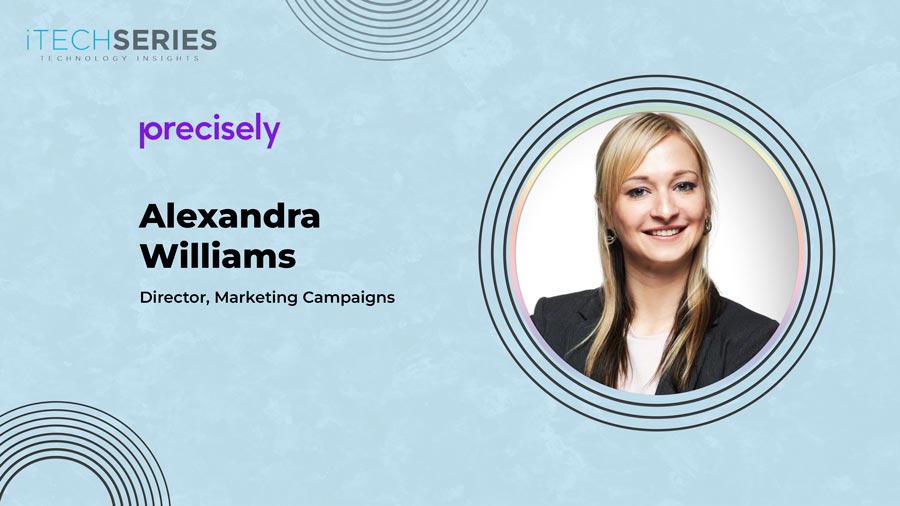
Alexandra Williams, Marketing Campaigns Director at Precisely, shares how global campaign strategy is evolving into a data-driven growth engine. She discusses balancing global brand consistency with local relevance, leveraging AI in campaign planning, aligning marketing with revenue outcomes, and building integrated programs that drive measurable pipeline impact across global markets.
Welcome to the interview series, Alexandra. Could you tell us a bit about yourself and your journey as a marketer?
I’m currently the Marketing Campaigns Director at Precisely, where I lead global campaign strategy focused on driving enterprise growth across our portfolio. My journey has been shaped by an international background—I was born and raised in Germany and studied International Business across Germany, the U.S., and the U.K., which gave me early exposure to different markets and perspectives.
My career began in international business roles, including an internship at the German American Chamber of Commerce and later with a German B2B technology company in the U.S. Early on, I supported trade shows, events, and business operations. While those roles were operational, they gave me firsthand insight into how marketing connects with sales, customers, and overall business growth. That experience sparked my interest in moving beyond execution and thinking more strategically about impact.
Over time, I intentionally built my career in B2B technology, focusing on digital marketing, global go-to-market strategy, and growth-driven campaigns. I’ve always enjoyed working with international teams, aligning different perspectives, and localizing global programs while maintaining consistency. Today, I’m passionate about positioning marketing as a true growth engine—building integrated, data-driven campaigns that create measurable pipeline impact and long-term value.
How do you ensure global campaigns are locally relevant while maintaining a consistent brand message?
For me, it starts with alignment on the core strategy. The messaging, positioning, and campaign objectives need to be clearly defined at a global level. That creates consistency. But how we activate that strategy locally is where flexibility and collaboration come in.
Earlier in my career at Copart, we ran campaigns tied to regional holidays, local regulations, and market-specific trends. For example, in many European countries, switching to winter tires is mandatory. We built a campaign around that insight, and after seeing strong engagement, we tested similar concepts in Canada. I’ve always believed in sharing best practices across regions and creating a culture of test-and-learn globally.
At Precisely, we ensure process alignment through a strong central marketing operations framework so that campaign execution remains consistent across regions. At the same time, we work closely with our international counterparts to localize delivery—whether that means adjusting webinar time zones, using recordings across regions, re-recording sessions with local speakers, or adapting to email regulations and market preferences.
The key is balancing structure with flexibility. You need a unified brand voice and clear governance, but you also need to empower regional teams to adapt tactics so the message truly resonates in their market.
What factors guide your decision-making when allocating budgets across regions with diverse growth potential?
My decision-making is grounded in performance data and business priorities. I look closely at historical KPIs, pipeline contribution, ROI, and lead quality to understand where we’re driving meaningful impact—not just activity, but revenue.
From there, I align with sales leadership and regional teams to assess growth potential and market opportunity. If a region shows strong momentum or strategic importance, we focus on the initiatives that will accelerate the pipeline most effectively—whether that’s targeted ABM programs, digital demand generation, or field support.
It’s about balancing what’s proven to work with forward-looking investments. Data gives us the foundation, but strategic alignment ensures we’re investing where we can create the greatest long-term growth.
Where have you noticed the biggest shift in marketing’s role within a broader go-to-market setup?
The biggest shift I’ve seen is marketing becoming far more integrated and accountable within the overall go-to-market strategy. It’s no longer just about generating leads—marketing is now expected to influence pipeline quality, revenue contribution, and customer experience across the full funnel.
AI is accelerating that shift. It allows us to optimize campaign management, analyze market trends faster, test messaging variations, and even use it as a strategic brainstorming partner. The speed and efficiency it brings are transforming how quickly we can go from insight to execution.
At the same time, AI doesn’t replace strategic thinking. It enhances it. The real value comes from combining AI-driven insights with internal performance data, market understanding, and experience. You still need critical thinking to ensure alignment with business priorities and brand positioning.
Overall, marketing has evolved into a data-driven, revenue-aligned function—and AI is helping us operate at that higher level of impact.
“Marketing has evolved into a data-driven, revenue-aligned function and AI is helping us operate at that higher level of impact.”
In what ways is AI reshaping campaign planning, personalization, and performance measurement?
AI is reshaping campaign planning by accelerating how we gather insights and identify opportunities. Instead of spending weeks analyzing trends or building messaging frameworks from scratch, we can use AI to surface market signals, generate variations, and pressure-test ideas quickly. It allows teams to move faster and be more agile in planning.
When it comes to personalization, AI helps us move beyond basic segmentation. We can analyze behavioral data, intent signals, and engagement patterns to deliver more relevant messaging at the right time. Especially in B2B, where buying cycles are complex, that level of precision makes a significant difference in engagement and pipeline quality.
In performance measurement, AI enables deeper analysis of campaign data—identifying patterns in conversion, predicting outcomes, and highlighting areas for optimization much earlier. Instead of reacting after a campaign ends, we can adjust in real time.
That said, AI works best when it’s combined with a strong strategy and clean data. It’s a powerful tool, but the real impact comes from aligning it with clear business goals and experienced marketing judgment.
How do you handle setbacks in marketing programs and turn them into actionable learning opportunities?
Not every campaign is going to perform—and even programs that worked well in the past don’t always guarantee the same results. For example, a webinar might generate strong engagement the first time, but simply replaying the same content later doesn’t always deliver the same impact. Buyer behavior changes, market trends shift, and audience expectations evolve.
When that happens, I see it as a learning opportunity rather than a failure. I go back to the data to understand what changed—was it timing, messaging, targeting, or overall market dynamics? From there, we test different approaches, whether that’s adjusting the format, refreshing the content, refining the audience, or changing the promotion strategy.
I strongly believe in a test-and-learn mindset. Marketing is dynamic, especially in B2B. The key is to stay agile, analyze performance objectively, and continuously optimize. Setbacks often provide the most valuable insights—and those insights help us build stronger, more resilient campaigns moving forward.
Beyond standard performance metrics, how do you define and measure the true success of your marketing programs?
Standard metrics like MQLs, open rates, or registrations are important—but they only tell part of the story. For me, the true success of a marketing program is measured by its impact on pipeline quality and revenue contribution.
I look at how campaigns influence the full buyer journey. Are we attracting the right accounts? Are leads converting into meaningful sales conversations? Is marketing accelerating pipeline progression? These indicators show whether we are creating real business value, not just activity.
I also consider alignment and long-term impact. Strong marketing programs should strengthen brand positioning, support sales enablement, and create repeatable frameworks that can scale globally. If a campaign helps improve collaboration across teams and builds a foundation we can optimize over time, that’s a success as well.
Ultimately, marketing should be a growth engine. When our programs drive measurable pipeline impact while strengthening strategic alignment across the organization, that’s how I define true success.
What key lessons from your marketing journey would you like to share with aspiring marketers?
One of the biggest lessons I’ve learned is to stay curious and be open to testing new ideas. We often have assumptions about how a campaign should perform, but buyer journeys are constantly evolving. What worked six months ago might not work today. Marketing is about testing, learning, and adapting—not about being right all the time.
AI is also reshaping how we work. It’s becoming a powerful tool for brainstorming, research, and optimization. But it doesn’t replace strategic thinking. The real opportunity is learning how to use AI responsibly and combine it with data, experience, and business understanding.
Another important lesson is to stay open to different perspectives, especially in global organizations. What works in one country won’t automatically resonate in another. Messaging, cultural nuances, and even campaign formats can perform very differently across regions. International teams often operate with different levels of resources and market maturity, so collaboration and empathy are essential.
For aspiring marketers, I would say: stay adaptable, stay data-driven, and stay open-minded. The most successful marketers are the ones who are willing to learn continuously and evolve with the market.
About Alexandra Williams
Alexandra Williams is a global B2B marketing leader with over a decade of experience in SaaS and technology. She specializes in global campaign strategy, go-to-market alignment, and driving integrated programs that deliver measurable business impact. Passionate about international marketing, she excels at translating complex solutions into clear, outcome-driven messaging and aligning cross-functional teams to scale globally relevant campaigns.