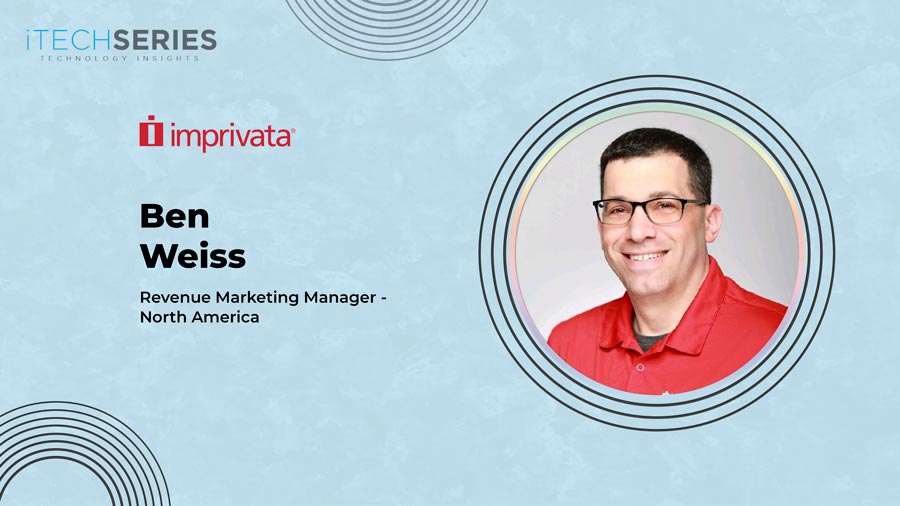
Ben Weiss, Revenue Marketing Manager – North America at Imprivata, shares his journey from tech support to revenue-focused marketing leadership. He explores marketing’s evolution from lead generation to full-funnel growth, the importance of sales alignment, data-informed decision-making, field marketing ROI, and using AI strategically to drive measurable pipeline impact and sustainable revenue performance.
Welcome to the interview series, Ben. Could you tell us more about yourself and your journey as a marketer?
Thanks for having me. Post-graduation, I started in tech support. After a little over a year of that, I had a flare of my Crohn’s disease. After recovering from that, I ended up in the nonprofit sector in a development and events role while I worked on my MBA. Post MBA, I hooked up with a small Agency, Acacia Marketing Group. While Acacia does not exist anymore, its impact on me was significant.
Acacia contracted out to Cognos, where I worked as a combination of Field and Events Marketer. From there, I spent time at IBM, some more agency time, then Salesforce, Cato Networks, and a short stint at AWS before landing at Imprivata.
Every role I have had required me to be a face and voice for sales. A true partner is someone whose challenges I understand and whom I help support by driving and progressing opportunities.
Where have you seen the biggest shift in marketing’s role within an integrated GTM setup?
Great question. The role of Marketing has shifted from lead generator to needing to focus on the full funnel from a revenue perspective. Instead of leads, it has turned into revenue and growth. Marketing is now expected to influence pipeline creation, acceleration, and conversion, working closely with sales to ensure measurable business outcomes and long-term customer value.
In what ways do data and analytics guide your GTM approach and optimize lead-generation initiatives?
Data and analytics are critical to decision-making, but I certainly operate under the guidance of taking in anecdotal evidence as well as data. Sometimes we look at the data and say wow this program did amazing, however, when we talk to sales who are following up on the leads, they say hey the quality of leads is not there. They responded, but they are not the right buyer for us. This must be taken seriously, independently validated, and then factored into your decision-making process.
I try to find balance in how I analyze lead generation initiatives and not weigh too heavily one method of analysis.
How do you prioritize marketing channels and tactics across digital, social, event, and ecosystem programs to maximize results?
Your goals and budget are key drivers in this prioritization exercise. It is almost like a game of Tetris. How can you achieve all the goals you have with all the resources you have access to, whether they be yours directly or other organizational shared resources?
For me, it starts with where you ‘have’ to be in terms of physical events. Where is your absence going to be conspicuous? Once that is determined and the right amount of budget is allocated, then you can augment your Always-on digital tactics with additional digital, ABM, organic, and paid social.
What are your best practices for delivering large-scale marketing programs on time and within budget?
Begin with the end in mind. Go to where you want to end and start planning backwards. The PMP Project Manager in me strongly encourages anyone planning to build enough float into their schedule. You need to allocate time for the chance that things can go wrong. The float allows you to absorb issues that pop up that you do not have control over. Beyond this, control the controllable, and you should finish on time or early.
Budget-wise, I think of it like a construction project. Always try to build in a contingency fund. Take 10-15% of your budget and set it aside for the unforeseen. Unspent money at the end of a project can always be spent to amplify or accent the project more.
“The role of Marketing has shifted from lead generator to needing to focus on the full funnel from a revenue perspective.”
How do you measure the real impact of field marketing and events beyond attendance or leads?
Another good question. A few factors here. A lot of it comes down to simple math. You need to consider how you are spending (event budget, sales conversion rate, and average deal size). By doing the math, if you close 20% of your deals, then you can, with hard numbers, show how much X ROI you generated.
Ideally, I like to see my pipeline coming out of an event at a minimum of 5x my budget. That way, in most cases, it gives me enough room to evaluate success based on how many opportunities come out of it, taking into account the factors previously mentioned.
Critical point here goes back to the beginning and the changing of the role of the Marketer. Pipeline is great, but closed business, even if a Marketer is not evaluated on it, is critical to proper evaluation and Sales and Marketing Alignment.
As a marketer, how do you leverage the power of AI tools without becoming overly reliant on them?
This could be a long answer, and I think, like most Marketers, I am trying to ensure that I am dabbling and using what I can while also still validating the information coming out of it.
Personally, I try to use it to replace systems or processes that can be done much faster and allow me to do other high-value tactics. I view AI as an accelerator, not a decision-maker. Human judgment, strategic context, and experience still need to guide the final output to ensure accuracy, relevance, and alignment with business goals.
What advice would you give to up-and-coming marketers on building the right mix of technical, creative, and strategic skill sets?
Simply put, never stop learning. The best way I can express it is to always know enough to be dangerous. Do not feel you need to know everything about everything, but know enough to be part of the conversation and use it to help move you through organizations.
Be coachable; understand that even people working in the field for 20 plus years are continuously learning. Coachability, humility, a strong work ethic, and the ability to learn to communicate with people at all levels.
About Ben Weiss
Ben Weiss is a strategic marketing leader with 20+ years of experience and a PMP-certified project manager. He has led complex, cross-functional global initiatives across agency and corporate environments, driving B2B demand generation and account growth. His expertise spans enterprise, SMB, channel, and OEM marketing, with strengths in sales alignment, technical systems integration, team development, field marketing, and large-scale event execution. He is also actively involved in community and sports organizations.