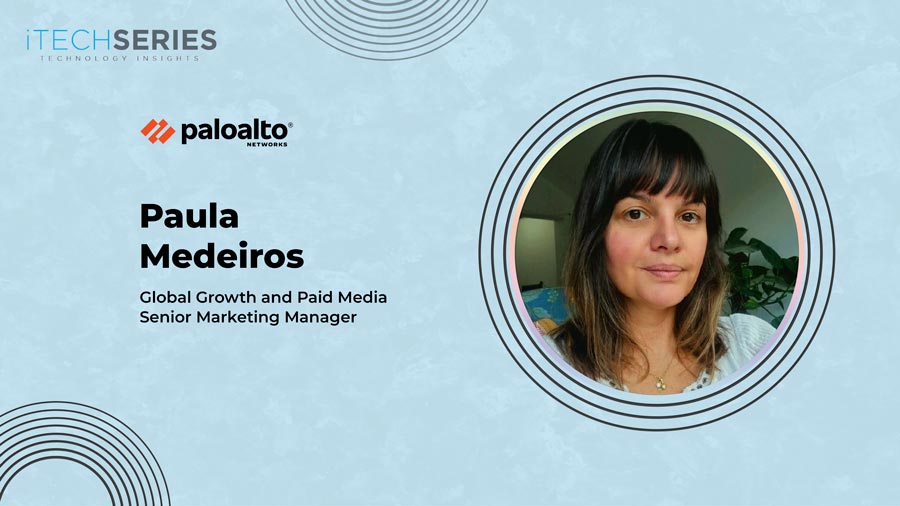
In this interview, Paula Medeiros, Global Growth and Paid Media Senior Marketing Manager at Palo Alto Networks, shares her perspective on integrated marketing as a scalable growth engine. She explains how aligning strategy with execution, balancing brand and revenue goals, and leveraging data and AI responsibly can transform fragmented efforts into measurable, sustainable business impact across global organisations.
Welcome to the interview series, Paula. Could you tell us more about yourself and your journey as a marketer?
Hi iTech team, thank you for talking to me!
I’m a B2B tech marketing leader with about 15 years of experience, and my journey has really been defined by moving from complexity to clarity.
I spent my first 10 years in the London agency ‘training ground’ delivering high-impact campaigns for brands like IBM, Dell, VMware, and SAP. That’s where I truly fell in love with digital marketing. I became obsessed with the agility of it, the ability to take a complex technical solution like IaaS or SaaS, put it in front of a global audience, and see in real-time what actually resonates with a human being on the other side of the screen.
For the last 5+ years, I’ve brought that digital-first mindset in-house to global players. At Oracle, where I led EMEA digital programmes, and most recently at Palo Alto Networks, I led business operations for the Global Paid Media team, introducing AI-powered workflows into the team processes.
What drives me today is the ‘science’ behind the strategy. I’m at my best when I’m helping organisations simplify complexity and scale impact. I don’t just design a plan; I’m genuinely energised by the operational excellence and data-driven tinkering that makes it work. I love the challenge of turning fragmented digital efforts into one clear, high-performing engine that delivers measurable business outcomes.
What does integrated marketing truly mean to you beyond multichannel execution, and how does it drive sustainable growth?
Great question! To me, integrated marketing represents the strategic bridge between a visionary brand identity and the hard commercial outcomes required for sustainable business growth. It is a philosophy that moves far beyond the logistical exercise of multichannel execution. While the latter often focuses on simply distributing content across various platforms, true integration is defined by seamless continuity across the entire customer journey. I believe that a senior marketing leader’s primary responsibility is to support the overarching business plan by aligning sales and marketing goals, ensuring that every touchpoint (from the initial awareness phase to the final transaction) is part of a unified, coherent narrative.
At the heart of this approach is the vital intersection of creativity and rigorous data analysis. I am passionate about building digital experiences that do more than just broadcast a message; they must find and engage the right customers in the right channels at the precise moment they are needed in their buying journey. This process is fueled by the mantra that without data, there is no insight. By ensuring that every campaign is fully traceable and every digital strategy is built on proven data, we create a feedback loop where execution can be analysed and improved continuously.
Ultimately, this level of integration drives sustainable growth by transforming fragmented, tactical efforts into a clear and scalable strategy. When we combine a seamless customer experience with operational excellence, we move away from isolated activities and toward measurable business impact. By fostering a culture of trust and high standards and by staying close to the execution of these data-driven strategies, we can ensure that marketing remains a powerful engine for long-term commercial success rather than just a series of disconnected events.
How do you strike the right balance between long-term brand building and short-term revenue or lead generation goals?
Striking the right balance between long-term brand building and short-term revenue is essentially the art of connecting vision to execution. As a strategic marketing leader, I believe these two goals should not be viewed in isolation; rather, they must be integrated into a clear, scalable strategy that moves an organisation from mere activity to measurable business impact. My approach is rooted in the belief that my primary job is to support the overall business plan by aligning marketing goals with results to secure sustainable growth.
I achieve this balance by combining strategic thinking with operational excellence, ensuring that while we are hitting immediate lead generation targets, we are also building digital experiences that enhance long-term audience engagement. For me, the combination of creativity and data analysis is key. Data provides the insight needed to find and engage the right customers in the right channel at the right time, while creativity ensures the brand remains resonant throughout the customer journey.
You’ve worked across global and regional leadership roles. How do you effectively connect high-level strategy to measurable execution?
In global and regional leadership, the bridge between a high-level vision and measurable execution is built through a rigorous and cascading approach to planning. I believe that for a strategy to be effective, it must act as a North Star that remains visible throughout every layer of the organisation, from overarching business objectives down to the most granular country-specific activities. My process begins by aligning the global business goals with the marketing organisation’s core objectives, ensuring that as plans become more specific at a regional level, they never lose sight of that primary strategic intent. This ensures that every local execution, no matter how small, is a direct contributor to the broader commercial mission.
Connecting these dots requires a unique combination of strategic thinking and operational excellence; it is not enough to simply design a plan; one must be deeply committed to the mechanisms that make it work. I focus on turning what can often be fragmented regional efforts into a clear, scalable strategy by ensuring that every touchpoint in the customer journey is fully traceable. By maintaining a “no data, no insight” mindset, I can ensure that execution is not just happening but is being continuously analysed and improved to meet the high standards required for global growth.
“Integrated marketing represents the strategic bridge between a visionary brand identity and the hard commercial outcomes required for sustainable business growth.”
As a global growth leader, what separates tactical campaign execution from truly strategic growth marketing?
I truly believe that the distinction between tactical execution and strategic marketing lies in the move from isolated activities to a cohesive, resilient system. While tactical execution focuses on the “what” and “where” of a single campaign, truly strategic growth marketing is about building a scalable “growth engine”. This engine is powered by an “always-on” campaign architecture that ensures a brand maintains a continuous presence and engagement throughout the entire customer journey. By moving away from fragmented, one-off efforts, a strategic leader creates a framework where marketing is not a series of stops and starts but a consistent driver of commercial outcomes.
For me, Strategic growth is only truly possible when this engine is supported by absolute clarity from the leadership team. Without a defined “North Star” and a clear understanding of business priorities, even the most sophisticated digital programmes can lose momentum. It is the responsibility of a marketing leader to provide this direction, ensuring that teams are empowered with the insight and high standards necessary to optimise performance or pivot rapidly as market conditions evolve. This alignment between high-level vision and granular execution is essential to secure long-term business growth.
In today’s integrated revenue organizations, how has marketing’s role evolved alongside sales and customer success?
In today’s integrated revenue organisations, the role of marketing has evolved from a top-of-funnel service provider to a central strategic partner that must be perfectly synchronised with sales and customer success. There is an increasing pressure for alignment because, in many large corporations, these functions still operate in silos, creating friction in the customer journey. I believe that the companies that manage to dismantle these barriers and nail this alignment are the ones that will ultimately come out on top.
This evolution is further accelerated by the fact that the AI revolution is now upon us. Without a unified strategy, the introduction of AI can lead to deeper silos, increased confusion, and significant delays in innovation. For me, successful integration means creating a seamless customer experience (CX) where marketing doesn’t just design the plan but ensures the operational excellence required to make it work across the entire lifecycle. By leading with trust and transparency, we can turn fragmented efforts into a clear, scalable strategy. In this new landscape, the role of marketing is to act as the architect of the “growth engine”, ensuring that every part of the revenue organisation is optimised and moving at the same speed toward the same commercial outcomes.
How do you and your teams leverage the power of AI-enabled tools without being over dependent on them?
Great question! In global tech marketing, leveraging AI-enabled tools is about enhancing human judgment rather than replacing it. Over the past year, I have been focused on building AI-powered workflows for my teams, which has been an immensely rewarding journey. However, I have found that integrating these tools is significantly more challenging when your basic processes are still evolving; AI cannot fix a broken process, it can only accelerate an efficient one. Therefore, the foundation must always be a clear strategy and operational excellence.
To avoid over-dependence, we ensure that our ‘growth engine’ is guided by a clear vision of where we want the operation to be in the next six to twelve months. We use AI to handle the heavy lifting of data analysis and tactical execution, but the final strategic decisions remain grounded in our overarching business plan. This balance ensures that we are on the right track to drive sustainable growth without losing the creative intuition (human-touch) that defines a high-performing marketing organisation.
What would be your advice to up-and-coming marketers on developing the right skills to succeed in today’s world?
My advice to up-and-coming marketers is to look beyond the technical horizon of specific platforms and tools. While it is tempting to focus on becoming an expert in the latest software or social channel, the most enduring and valuable skill set is the ability to think strategically and develop a long-term vision. For me, the marketers who succeed are those who can simplify complexity and connect a brand’s creative vision to the hard commercial realities of the business.
I often tell my teams that a senior marketer must understand the weight of their decisions; a single campaign or digital experience has the power to either build immense brand equity or, conversely, negatively impact a company’s stock price. You must view yourself as a business leader first and a marketer second. Also, the ability to lead with calm judgment, maintain high standards, and bridge the gap between high-level strategy and granular execution will always be the hallmark of a successful marketing leader.
About Paula Medeiros
Paula Medeiros is a global marketing leader in the technology sector, known for connecting strategy to execution to drive measurable business impact. She specialises in scaling commercially grounded marketing programs, strengthening operating models, and aligning global teams around clear outcomes. With a collaborative, people-first leadership style, Paula focuses on operational excellence, efficiency, and long-term growth while mentoring high-performing teams in complex, fast-moving environments.