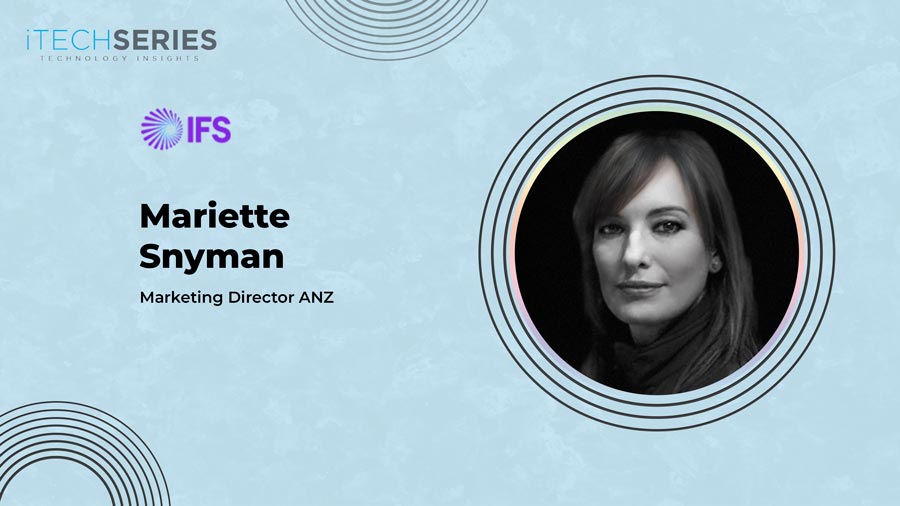
Mariette Snyman, Marketing Director ANZ at IFS, shares her perspective shaped by over two decades of leading marketing across complex enterprise environments. She explores how intent-driven ABM evolves into account-based experience, why trust and coherence accelerate buying decisions, and how alignment among marketing, sales, and leadership drives sustained pipeline growth and long-term enterprise value.
Your career spans over 26 years across brand, demand, GTM, and leadership. Looking back, what defining moments shaped how you think about marketing today, and what lessons still guide your work?
One of the most defining shifts in my career was realising that marketing doesn’t fail because teams don’t work hard—it fails because they don’t have space to think.
Modern B2B marketing is stuck in execution mode. Teams operate at full capacity, reacting to targets, tools, and timelines, and mistaking activity for progress. The impact is subtle but serious: leads get burned, creativity declines, and teams fall back on “what’s worked before” instead of designing experiences around how customers actually buy.
Early in my career, in highly regulated financial services, I was part of a team that delivered a 14x improvement in conversion performance over three years. That transformation didn’t come from working harder—it came from stepping back and recognising a core truth: people don’t choose the best option. They choose what feels familiar, credible, and least risky.
In that environment, trust wasn’t a brand attribute—it was the commercial strategy. That lesson still shapes my work in enterprise B2B SaaS. Technical superiority alone is rarely enough. Brands win when they become cognitively easy to choose, built through consistency, repetition, and emotional resonance over time.
Across more than two decades working across industries and regions, I’ve learned that marketing only works when it respects human behaviour and commercial reality. The moments that shaped me most weren’t campaign wins, but when marketing built trust—with customers, sales teams, and leadership. Today, my work balances emotional connection with measurable growth, a philosophy central to my leadership and writing.
In your experience, what separates ABM programs that genuinely move complex enterprise deals forward from those that simply generate activity and dashboards?
The difference lies in intent.
ABM underperforms when it’s treated as a targeting exercise rather than a relationship strategy. On the surface, it may look sophisticated—personalised ads, bespoke assets, segmented lists—but it fails to influence the actual buying decision because it doesn’t change the buyer’s perception of risk, relevance, or credibility.
In a recent role leading regional marketing for a global enterprise SaaS platform, we redesigned our approach. That discipline contributed to three consecutive years of triple-digit pipeline growth, with each year outperforming the last.
The shift wasn’t more activity—it was greater coherence. High-performing ABM programs are rooted in behavioural insight. They start with a deep understanding of how buying groups make decisions under pressure, uncertainty, and internal politics. They recognise that what accelerates enterprise deals is not more assets, but relevance, consistency, and trust over time.
This is where ABM naturally evolves into ABX—account-based experience. Buyers don’t engage with channels; they experience brands. When marketing, sales, partners, and proof points work together to reinforce a coherent narrative, trust compounds. When they don’t, momentum stalls—no matter how much activity is generated.
Leading distributed teams and partners is now the norm. How do you create accountability and momentum without micromanagement or burnout?
The biggest leadership mistake in distributed marketing teams is trying to solve complexity with more control.
Accountability scales when teams are aligned around outcomes, not activities. Leading APAC marketing for a high-growth technology business across three markets, I reported to both regional leadership and a global CMO. Brand inconsistency wasn’t caused by poor intent—it was caused by too many tools, too many interpretations, and no shared definition of what “good” looked like.
So we built operating clarity: a single messaging framework every market could adapt, clear ownership across the customer journey, and playbooks that removed decision fatigue rather than added process. We established three-month forward planning cycles so teams weren’t constantly reacting. And we protected thinking time—no internal meetings on Fridays, no reporting theatre.
When people understand the experience they’re responsible for—not just the tasks they’re assigned—accountability becomes self-sustaining. My approach is to design systems that create clarity, not control. That means a single source of truth for messaging, explicit ownership at every stage of the customer journey, and playbooks that empower rather than constrain.
Equally important is trust. High-performing teams don’t emerge from pressure alone; they emerge from psychological safety, autonomy, and respect for expertise. In distributed environments, trust is your operating system. You can’t micromanage across time zones. You need people who understand the “why” deeply enough to make the right call when you’re not in the room.
As marketing becomes more embedded across sales, customer success, and product, how have expectations of the marketing function evolved?
Marketing is no longer evaluated on output—it’s evaluated on commercial influence.
In my current role, the expectation from day one was clear: marketing needed to be a revenue partner, not a campaign factory. That meant co-owning pipeline quality, deal velocity, customer perception, and brand equity at the same time.
Today, marketing is expected to reduce uncertainty in complex buying decisions. That includes building brand credibility, enabling sales with insight rather than just assets, shaping conversations earlier in the cycle, and reinforcing confidence at the point of decision.
Marketing is no longer a support function; it’s a commercial partner. Leaders are expected to influence pipeline quality, deal velocity, customer perception, and long-term brand equity simultaneously. That requires marketers to think like business leaders, not campaign managers.
This shift has exposed a structural challenge. Many organisations still treat alignment as cooperation rather than shared ownership. True cross-functional alignment means marketing and sales co-design the journey, agree on success metrics, and hold each other accountable for the experience—not just the handover.
When that happens, marketing stops being reactive and becomes a strategic growth lever. That’s how we’ve delivered sustained triple-digit pipeline growth—not through heroic campaigns, but through disciplined commercial partnership.
Many organisations talk about aligning brand, demand, and revenue. In practice, what does true alignment actually look like, and why is it so hard to achieve?
True alignment is not conceptual—it’s behavioural.
I’ve seen misalignment kill deals at the final stage. Brand promises one experience, the sales pitches another, and the product delivers a third. The buyer can’t reconcile the signals, so they hesitate—and in enterprise B2B, hesitation kills momentum.
Brand, demand, and revenue are aligned when the story a buyer hears at first touch is reinforced at every subsequent interaction and ultimately delivered through the commercial experience. When those signals diverge, the brain registers inconsistency—and inconsistency creates hesitation.
Earlier in my career, working in a highly regulated environment, we ran a full corporate rebrand while simultaneously delivering a 14x improvement in conversion performance. That only worked because every touchpoint—advertising, direct marketing, events, sales conversations—reinforced the same three value propositions in consistent language.
True alignment happens when the brand is not treated as decoration and demand is not treated as a numbers game. In practice, it means the promise you make through the brand is reinforced by demand programs and fulfilled by the sales and customer experience.
Alignment is hard because it requires discipline over time. It means saying no to fragmented messaging, resisting short-term noise, and committing to repetition even when teams internally feel, “We’ve already said this.”
“Marketing becomes a strategic capability when it stops optimising campaigns and starts building systems that compound over time.”
With AI now embedded across marketing, how do leaders scale performance while protecting human insight, creativity, and judgment?
AI is extraordinarily powerful—and deeply unforgiving.
The real risk isn’t that AI will replace marketers—it’s that marketers will stop thinking critically and allow speed to replace judgment. I’ve seen teams use AI to generate content, build campaigns, write emails… but nobody’s asking the hard question: should we even be doing this?
AI amplifies whatever already exists. Strong brands become stronger. Weak positioning becomes more visible. A bad strategy executed faster is still a bad strategy.
I approach AI as an augmentation layer, not a decision-maker. Used intentionally, it can accelerate analysis, drafting, pattern recognition, and execution. That reclaimed time should be reinvested into insight, creativity, and experience design—the things machines cannot do.
After more than two decades leading marketing teams, I know what works isn’t always what’s efficient. Trust gets built in pauses, in listening, in knowing when to slow down. AI has no intuition for that. Human judgement remains essential because trust, emotion, and risk perception are still human decisions—especially in enterprise buying.
The leaders who succeed will be those who treat AI as an operational layer, not a strategic brain.
Beyond revenue and pipeline, what signals do you watch to understand whether marketing is truly working?
I focus on leading indicators of confidence, trust, and momentum.
That includes brand familiarity within target accounts, engagement across multiple stakeholders, sales confidence in marketing messaging, deal progression quality, and the presence of credible proof points like customer advocacy and peer validation.
In one role, we tracked repeat content engagement as a leading indicator—when someone came back to our thought leadership three or four times, that wasn’t polite interest, that was intent. We also watched how quickly prospects invited colleagues into the conversation. If they were willing to bring someone else in early, we’d build credibility.
Some of the most important signals are qualitative: how customers talk about you when they’re not being prompted, how sales teams describe your value proposition in their own words, and how consistently your messages show up across touchpoints. These reveal whether marketing is actually doing its job.
Revenue confirms success—but trust predicts it.
For marketers aspiring to leadership roles, what mindset shift matters most as they step into greater responsibility?
The most important shift is moving from execution thinking to systems thinking.
When you’re an individual contributor, your value comes from being the best executor. When you step into leadership, your job is no longer to have the best ideas—it’s to create the conditions where the best ideas can come from anyone.
That’s uncomfortable, especially if you got promoted because you were the person with the answers. I mentor emerging marketers, and I see this tension constantly. They think leadership means being the smartest person in the room. I tell them it means building the room where smart people can do their best work.
Marketing doesn’t work in isolation. Brand, demand, ABM, events, partnerships, and community—they only create impact when they reinforce each other. Sporadic activity creates noise; consistent systems create momentum.
The biggest shift is moving from proving value to creating value for others. Leadership in marketing isn’t about being the smartest person in the room—it’s about setting direction, building belief, and creating space for others to perform at their best.
I’d also encourage emerging leaders not to lose their love for the craft. Strategy without creativity is sterile. Creativity without strategy is chaos. Marketing works best when it’s grounded in curiosity, genuine care for people, and a relentless focus on what actually moves the business forward—not just what looks good in a report.
You’ve worked across both B2C and B2B, regulated industries and high-growth tech. How do you think about marketing’s role in shaping business strategy—not just executing it?
Marketing’s greatest strategic contribution isn’t producing campaigns—it’s providing market intelligence that shapes how the company competes.
Earlier in my career, I was part of an executive committee in a highly regulated financial services environment where we led a complete market repositioning. The business problem was clear: we were losing ground to competitors, customer trust was eroding, and our brand had become invisible to a critical growth segment.
The solution wasn’t better advertising—it was a fundamental shift in market positioning backed by a strategic brand transformation. We introduced a brand ambassador program that put a human face on a previously faceless institution. We repositioned our messaging to speak directly to an underserved segment that competitors had ignored. And we rebuilt trust by aligning every customer touchpoint—from product design to sales conversations to post-sale service—around a single, credible promise.
The results were significant: we claimed measurable market share in that new segment, reduced customer acquisition costs substantially, elevated brand equity to levels the organisation had never achieved, and contributed to revenue growth that exceeded all projections.
That experience taught me that marketing’s strategic role is to answer questions the business doesn’t yet know to ask: Where is customer perception moving? What does the competitive landscape actually look like from the buyer’s perspective? What markets are we ignoring that we should own? Where is our brand creating friction instead of trust?
Many companies treat marketing as a service function. What does it look like when marketing becomes a strategic capability that drives long-term enterprise value?
Marketing becomes a strategic capability when it stops optimising campaigns and starts building systems that compound over time.
Most organisations still measure marketing by this quarter’s pipeline or this month’s MQLs. But enterprise value isn’t built in quarters—it’s built through sustained brand equity, customer lifetime value, competitive positioning, and market leadership that endures regardless of who runs marketing next year.
I’ve spent 26 years building marketing functions, not just running programs. That means creating frameworks that outlast individual campaigns, establishing operating rhythms that maintain alignment as priorities shift, and developing people who can lead, not just execute.
In one organisation, we built a repeatable system to turn customer success into market credibility. Every closed deal contributed to a proof-point library. Every satisfied customer became a potential reference, case study, or speaker. Every product launch was reinforced by customer advocacy, not just paid media. The system didn’t depend on heroic individual effort—it was embedded into how marketing, sales, and customer success worked together.
The result was a compounding advantage. In year one, advocacy engagement was modest. By year two, we had a library of more than 40 proof points across industries and use cases. By year three, buyers came to us because they’d seen customers speak at events, read case studies, or received direct referrals. The system created momentum that advertising alone could not.
Marketing becomes strategic when it builds capabilities that increase enterprise value: brand equity that supports premium pricing, customer advocacy that shortens sales cycles, thought leadership that shapes perception, and operational discipline that makes growth repeatable.
You’re writing *The Golden Goose of Tech Marketing – Creating Profits, Not Just Laying Eggs. * What’s the core problem you’re solving, and why does it matter now?
The problem is simple: most marketing teams are exhausted, overwhelmed, and still not delivering the commercial results their organisations need.
The book emerged from a frustration I’ve seen repeatedly across two decades in tech marketing. Teams are drowning in tools, tactics, and noise—AI, ABM, intent data, neuromarketing, personalisation engines—while losing sight of the fundamentals that actually drive ROI: clarity, consistency, and commercial discipline.
Everyone is chasing the golden egg—the perfect campaign, the viral post, the magic automation—when what businesses really need is the golden goose: a marketing function that reliably generates profit, velocity, and enterprise value over time.
The book distils the frameworks I’ve used to build high-performing marketing engines in complex environments. It isn’t theory; it’s grounded in real transformation. How do you move conversion from 4% to 58%? How do you deliver 100%+ year-on-year pipeline growth? How do you build marketing that sales teams trust and boards respect?
It addresses the complexity leaders face today—AI, behavioural science, account-based strategies, and cross-functional alignment—but always through a commercial lens. The question isn’t “Can we use AI?” It’s “Will this create velocity, trust, and margin?”
I wrote it for marketing leaders tired of being measured on activity and ready to be accountable for outcomes. For CMOs and VPs who must translate marketing’s strategic value to boards and investors. And for emerging leaders who want to build marketing as a business function, not just a creative department.
About Mariette Snyman
Mariette Snyman is an enterprise and commercial marketing leader with more than 26 years of experience leading global and regional go-to-market strategy across B2C, regulated industries, and enterprise B2B SaaS. She brings deep expertise in brand, ABM/ABX, revenue alignment, and enterprise buying behavior. A 2025 SACC Business Professional of the Year awardee, she partners with CEOs and executive teams to drive growth, trust, and long-term enterprise value and is the author of The Golden Goose of Tech Marketing.