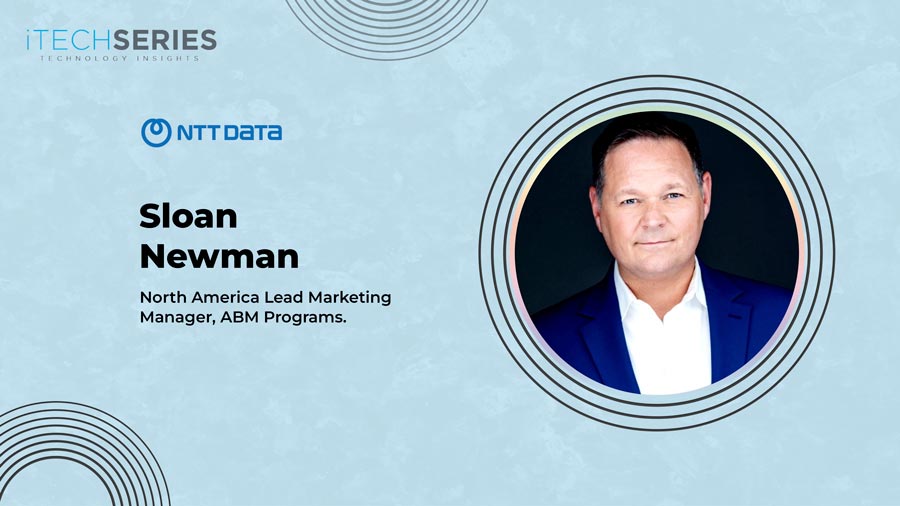
Sloan Newman, North American ABM Manager at NTT DATA, shares his journey from international agency experience to leading award-winning marketing programs. In this conversation, he discusses account-centric strategies at scale, balancing global frameworks with regional flexibility, and building high-performing teams, emphasizing how relationships, alignment, and precision transform modern marketing beyond traditional metrics.
Welcome to the interview series, Sloan. Could you share your journey to becoming a marketing leader?
Thanks for having me—and for including me in the iTech Series Unplugged. I’m genuinely honored to be part of the conversation.
I’ve never been especially comfortable calling myself a “leader.” For me, progress has always come from people, relationships, and shared ownership—not individual titles. That belief sits at the center of both my career and my writing.
My path into marketing started early. I’m the son of two public relations professionals, so storytelling and messaging were part of everyday life growing up. After beginning my career at an agency in Charleston, South Carolina, I completed graduate studies in International Marketing Strategy and Communications in London and France. Living and working internationally taught me that marketing isn’t just tactical—it’s contextual.
I spent six years on the agency side with MSL London, Life Healthcare Communications, and KRISPIN Marketing in Germany, learning how to earn trust quickly and align stakeholders under pressure. I returned to the U.S. in 2011 to join Microsoft Advertising and then went on to lead marketing teams across service-based organizations in the Puget Sound.
That path eventually led me to NTT DATA’s Global IP Transit division. In 2022, I stepped into the role of North American ABM Manager. In 2023, the work we did as a global team was recognized for the Forrester’s Program of the Year award, along with honors from Marketing Week and B2B Marketing. Those awards validated a long-held belief: when marketing is built around relationships and long-term value, it works—at scale.
Where have you seen the most significant change in marketing’s role within GTM?
Marketing has evolved from a lead factory to an account orchestrator.
Earlier in my career, marketing was measured by volume—generate leads, pass them to sales, and move on. Today, that model no longer works, especially in enterprise environments.
Marketing now plays a central role in shaping the full client experience, from first intent signal through expansion and renewal. It interprets buying-group behavior, surfaces readiness, and enables sales to engage at the right moment with the right context.
When done well, this approach increases velocity, shortens sales cycles, and improves lifetime value. More importantly, it creates continuity. Accounts don’t experience marketing, sales, and customer success as separate motions—they experience one connected relationship.
That’s the real shift: not more activity, but more alignment.
When starting an ABM program from zero, what steps matter most?
Strong leadership and a single point of truth are foundational.
A key success factor that I’ve seen when developing an ABM program from zero is the development of a Center of Excellence that provides structure, governance, and consistency—while still empowering regions to execute locally.
The next step is clarity. Organizations need to define what ABM actually means for them: strategic 1:1 engagement, industry plays, opportunity-focused programs, or a blend. Not every model fits every business, and prioritization is critical.
Commitment is also non-negotiable. ABM isn’t a quick fix—it often requires sustained investment over several years. I’ve seen long-term, relevant engagement consistently outperform short-term funnel-filling tactics.
Finally, start with clean data. It remains one of the hardest disciplines to maintain—but it’s what enables real intent, insight, and relevance at scale.
How do you decide between 1:1 and 1:few ABM programs?
I often start with the 80/20 rule: most organizations generate the majority of revenue from a small percentage of accounts.
Those accounts demand Strategic—or 1:1—ABM. This is reserved for high-complexity, high-value relationships where long-term impact matters most. It’s where deep personalization and true partnership make a difference.
1:few ABM is how you scale that discipline. When accounts share similar challenges or buying dynamics, you can adapt programmatic or industry content to serve a defined audience without starting from scratch.
I think of it this way: 1:1 ABM is a spotlight; 1:few ABM is a stage light. The strongest GTM strategies use both—intentionally.
“A key success factor in developing an ABM program from zero is creating a Center of Excellence that provides structure, governance, and consistency—while empowering regions to execute locally.”
How do you balance global ABM frameworks with regional flexibility?
That balance has to be designed from the start.
Our global frameworks provide consistency in process and governance, particularly around onboarding and measurement. What’s never standardized is the account experience.
No two accounts behave the same—and effective ABM requires listening deeply. That’s why I often say ABM leaders must operate as the CMO of their accounts. Context matters, and what resonates in one market may not in another.
The best ABM practitioners aren’t rigid rule-followers—they’re problem solvers. Flexibility is what allows ABM to scale without losing relevance.
What has been your most memorable experience as a marketer?
One experience stands out: my time at MSL London.
After completing graduate studies, I worked on a five-year marketing plan for The West End Company, representing Oxford, Regent, and Bond Streets. That work led to a role on MSL London’s business development team in Kensington.
Soon after joining, I was asked to step into a leadership gap—leading senior meetings, contributing to high-stakes pitches, and learning firsthand what it meant to win and lose major opportunities. I also worked closely with UK government stakeholders and Publicis sister agencies.
What made it memorable wasn’t the accounts—it was the people. Being accepted by some of the most creative and strategic minds I’d worked with gave me confidence that shaped how I approach my work to this day.
Beyond traditional KPIs, how do you measure marketing impact?
Revenue and pipeline matter—but they’re lagging indicators.
In 1:1 ABM, we look at buying-group expansion, executive engagement, multi-threaded relationships, and progression from marketing engagement to sales-led conversations. We also measure account team adoption—whether insights are embedded in account plans and actively used by sales.
Velocity matters too: shorter cycles, larger deal sizes, and stronger executive relationships signal trust, not just activity.
The goal isn’t more motion—it’s more precision.
What capabilities matter most when building high-performing marketing teams?
I value cleverness over sameness.
The strongest teams aren’t built from identical skill sets—they’re built from complementary strengths. When that balance exists, collaboration is natural, ideas circulate freely, and the work improves collectively.
Passion and technical skill matter. But the defining trait of high-performing teams is their ability to collaborate deeply, communicate openly, and adapt in real time.
That’s what I prioritize most—and what I enjoy being part of most.
About Sloan Newman
Sloan Newman is a marketing leader with 20+ years of experience driving growth through Account-Based Marketing, demand generation, and brand strategy across B2B, B2C, nonprofit, and healthcare sectors. At NTT DATA, he leads North American ABM and demand generation programs, expanding the pipeline, creating multi-million-dollar opportunities, and strengthening C-suite relationships. His career spans global event marketing, branding, and business development, earning recognition as an award-winning marketer passionate about strategic, data-driven, and measurable impact.