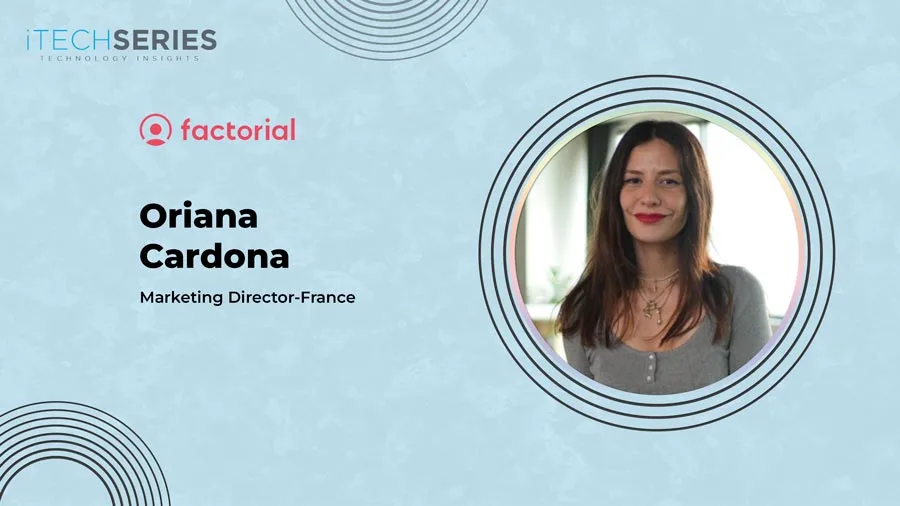
Oriana Cardona, Marketing Director, France, at Factorial, shares how she blends data, creativity, and customer insight to build high-precision marketing engines. In this conversation, she discusses the foundations of effective ICP design, full-funnel orchestration, cross-functional GTM alignment, and the evolving role of AI, revealing what it truly takes to drive scalable, revenue-focused growth today.
Welcome to this interview series, Oriana. Could you tell us about what got you into the world of marketing?
I originally entered the world of marketing through the digital agency world. I started my career working with clients across different industries, and very quickly I realised how powerful performance marketing could be for solving business problems. That experience pushed me to deepen my skills. I completed a UX/UI bootcamp and then moved into acquisition roles, where I learned to combine data, creativity, and experimentation. From there, marketing became a natural path for me: I loved understanding user behaviour, building growth strategies, and seeing a direct impact on revenue. This mix of analysis, creativity, and impact is what got me into marketing, and what still motivates me today.
What are the core principles behind a successful demand-generation engine?
For me, demand generation works when three things are very clear: who we’re targeting, how we orchestrate the full funnel, and how aligned we are with Sales.
First, everything starts with the ICP and segmentation. If you don’t know exactly who you’re trying to reach and what problem you’re solving for them, the rest becomes noise. I like to be very intentional about pain points, value prop, and messaging by segment.
Second, a successful demand engine is full-funnel by definition. It’s not just about generating leads—it’s about creating awareness, capturing intent, and then making sure the journey is consistent all the way to revenue. Paid, content, product marketing, events, brand… for me all of these need to work together with a clear narrative.
And finally, strong collaboration with Sales. I believe demand generation only works when there is a shared pipeline, shared KPIs, and constant feedback loops. Otherwise, marketing optimises for one thing, sales for another, and we lose efficiency.
So for me, the core principles are: clarity on the ICP, a coordinated full-funnel approach, and very strong alignment with Sales. That’s when demand generation actually scales and creates real impact.
How do you adapt messaging and strategy for different customer segments within the same brand ecosystem?
The first thing I do is look at the pain points and motivations of each segment. Even within one ecosystem, a small business, a mid-market company or an enterprise don’t react to the same triggers. So I always start by mapping the core problems they’re trying to solve, their level of maturity, and the language they naturally use.
Once this is clear, I keep the brand narrative consistent, but I adapt the value proposition. For example:
- With smaller companies, I focus more on simplicity, time savings and quick wins,
- With mid-size companies, I highlight productivity, automation and efficiency,
- And for enterprise, I shift the message towards scalability and integration
Same product, but the story is told through the benefits that matter to them. And finally, I adapt the activation strategy: the channels, the content format, the level of education needed, and the sales involvement vary a lot by segment. Some audiences respond to performance and self-serve, while others need deeper product marketing and sales enablement.
How has B2B marketing changed with the rise of personalization and data-driven strategies?
Before, B2B was more about broad messaging and volume. Now, everything is about relevance and timing. Personalization and data have made us move from “pushing messages” to actually understanding where each account or user is in their journey, and adapting to that. For me, the biggest change is that generic campaigns don’t work anymore. People expect the same level of personalization they get in B2C: tailored content, tailored onboarding, tailored product value. And with the amount of data we have now, we can actually deliver that, through intent signals, behavioural scoring, segmentation, and dynamic messaging. It has also changed the collaboration between Marketing, Product and Sales. Data forces alignment. You can’t build demand, nurture, and convert without a shared view of the pipeline, the scoring model, and the buyer journey. So the relationship becomes much more integrated.
The last big change is the mindset. B2B marketing used to be about generating leads. Today, it’s about creating pipeline efficiency: quality, velocity, intent, and scalability. Personalization helps us reduce waste, focus on the right accounts, and activate the right message at the right time. So overall, personalization + data have made B2B marketing more precise, more aligned with revenue, and much more user-centric, which, for me, is a great evolution.
“For me, demand generation works when three things are very clear: who we’re targeting, how we orchestrate the full funnel, and how aligned we are with Sales.”
When you have multiple campaign proposals, how do you decide which one to move forward with?
First, I go back to the business objective. A campaign can be great creatively, but if it doesn’t clearly support pipeline, awareness, or a strategic segment, it’s not the right one. So I check: which proposal serves the goal best?
Then, I look at expected impact versus effort. I’m very data-driven, so I check historical learnings, benchmarks, audience size, cost, and expected pipeline contribution. The idea is to prioritise what will create the biggest outcome with the healthiest level of investment.
I also look at feasibility and timing. Some campaigns are amazing on paper but need resources we don’t have or take too long to ship. I prefer campaigns we can launch well, not campaigns we can only launch “theoretically”.
And finally, I think alignment is key. The best campaigns are the ones Sales, Product Marketing and Brand can all support, because that’s how you maximise consistency and performance across the funnel.
So in the end, I choose the campaign that:
- best serves the business goal,
- shows the strongest potential impact based on data,
- is realistic to execute well,
- and has cross-team
That’s how I make sure we move forward with the right one, not just the most exciting one.
How are you leveraging AI to improve marketing efficiency and outcomes?
AI is now omnipresent in marketing, and the biggest shift is that it can be leveraged at every stage of the funnel, from awareness to retention. It’s not just a tool; it’s becoming part of the operating system of modern marketing.
At the top of the funnel, AI improves market understanding and accelerates audience research. It helps analyse search trends, competitive signals, and cultural moments, allowing brands to build messaging that is more relevant, faster, and based on real behavioural data instead of assumptions. AI also speeds up creative production and content exploration, enabling teams to test more angles and formats quickly while staying consistent.
In the mid-funnel, AI enhances personalisation and intent prediction. Through behavioural clustering, propensity scoring, and dynamic content, brands can adapt the narrative based on where users are in their journey, what they care about, and what signals they show. This reduces noise, improves engagement, and makes nurturing more efficient. AI also supports campaign optimisation by spotting patterns humans might miss.
At the bottom of the funnel, AI strengthens alignment between marketing and sales. It enriches data, qualifies intent more precisely, recommends next best actions, and helps prioritise accounts with the highest likelihood to convert. AI-driven insights improve conversion velocity and remove friction in the buying process.
After conversion, AI becomes key for retention and expansion. It detects churn risk, identifies upsell opportunities, and personalises customer communication. It also analyses product usage to tailor lifecycle campaigns and create more relevant customer experiences.
Overall, AI is reshaping the entire funnel, not by replacing people but by amplifying capabilities. It brings scale, speed, accuracy, and personalisation to every stage, and is becoming essential for teams that want to stay competitive and efficient.
As a GTM leader, how do you ensure a strong collaboration between marketing, product, sales, and customer success?
Strong GTM collaboration doesn’t happen naturally; it has to be built intentionally. And it’s always a challenge. Cross-functional work creates friction because teams have different incentives, timelines, and perspectives. That’s why a clear structure is essential.
First, everything starts with shared goals and a unified narrative.
If marketing, product, sales, and CS aren’t aligned on the same ICP, value drivers, and definition of success, you quickly create parallel strategies that don’t connect. I always push for clarity upfront: one North Star and one shared story.
Then I focus on structured rituals.
Weekly touchpoints, shared planning, and continuous feedback loops from sales turn collaboration into a system, not a “nice to have.” These rhythms reduce surprises and keep everyone close to the market.
The real foundation for alignment is being data-driven.
Many organisations still base feedback on personal feelings or isolated anecdotes. Feelings matter and give context, but they don’t align teams because everyone can feel something different. Data is the only common language.
So I think it’s essential to build a culture where every team, regardless of role, is trained to read data, question it, and use it to support their feedback. When everyone speaks the same language—numbers, insights, customer signals—friction becomes productive instead of emotional.
Of course, not everyone adapts at the same speed. Some find it hard to shift to a data-led, cross-functional mindset; others thrive and become stronger contributors. But this expectation elevates the whole organisation and creates a healthier GTM motion.
For me, the formula is simple: shared goals, structured rituals, radical transparency on data, and a culture that blends empathy with accountability. With that, friction becomes normal but manageable, and teams move in the same direction.
What insights or guidance would you give aspiring marketers as they work toward a successful career?
Honestly, the best advice I can give to aspiring marketers is to stay curious, stay humble, and stay extremely close to the customer. Marketing evolves so fast that your ability to learn will matter more than anything you already know.
First, I think it’s essential to develop a real curiosity for data, not in a technical way but in a mindset way. Data helps you make better decisions, challenge your assumptions, and avoid doing things just because you feel. Feelings matter, but data is what creates alignment and clarity.
Second, build range. Don’t limit yourself too early to one area. Explore brand, acquisition, product marketing, lifecycle, and sales. The more you understand the whole GTM motion, the stronger you become. Marketing is no longer a silo; it touches product, revenue, CX, and strategy.
Third, learn to communicate clearly, and I say this as someone who is still working on it myself. It’s not always easy. But clarity is a superpower: it aligns teams, accelerates decisions, and removes ambiguity. It’s a skill you keep improving over time.
Fourth: embrace feedback, even when it feels uncomfortable. In high-growth environments, feedback is what makes you grow faster than you could alone. Some people find it difficult, others really thrive with it, and those are the ones who grow the fastest.
And finally, don’t forget to stay human. Marketing is about understanding people, their emotions, habits, frustrations and motivations. If you can combine empathy with analytical thinking, you’ll be unstoppable.
So my advice would be: stay curious, stay data-driven, understand the full funnel, communicate with intention, and be brave enough to grow through feedback. That’s what accelerates a marketing career.
About Oriana Cardona
Oriana Cardona is a seasoned marketing leader and currently serves as Marketing Director at Factorial. She began her career in digital agencies before leading acquisition at Malt, building high-performing, multi-country growth programs. After completing an executive program in Los Angeles, she became Head of Marketing for Spain at Doctoralia. A founder of Talk2me and Spicy Leads, she also champions gender equality and created the Women in Health Scholarship in Spain.