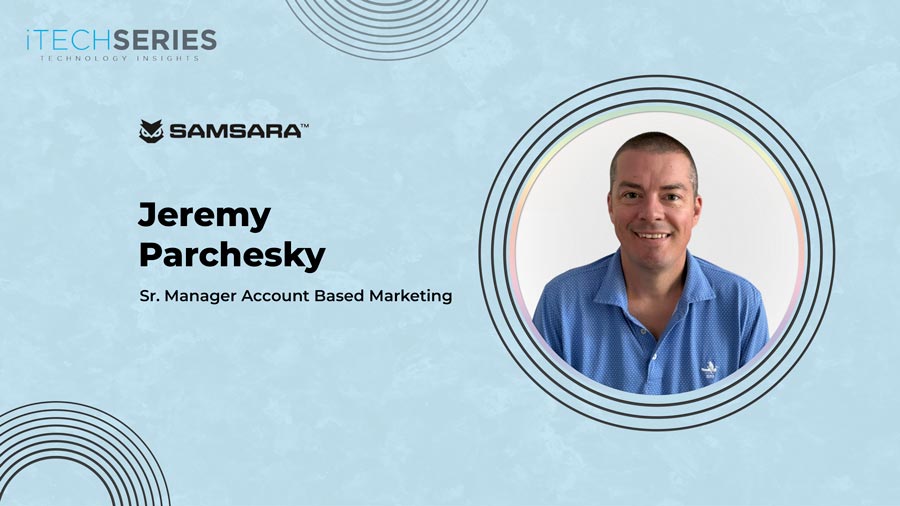
Jeremy Parchesky, Sr. Manager, Account-Based Marketing at Samsara, shares insights on building scalable GTM engines through revenue-driven ABM, intent data, and sales-marketing alignment. Drawing from his experience across diverse industries, he explores practical strategies for identifying buying signals, personalizing engagement, leveraging AI, and turning account intelligence into pipeline and measurable revenue growth.
Welcome to the interview series, Jeremy. Could you tell us about yourself and your marketing journey?
My marketing background is quite diverse. The journey started as an intern with Bose on their Voice of the Customer team. While still in college, I also interned with the Athletic Department at Ohio State, where I learned how closely sales and marketing must work together to drive success. After spending some time in sales across a few different organizations, I realized it wasn’t my true calling. I transitioned into marketing, working across various industries—from public sector organizations and e-commerce companies to Fortune 500 enterprises. I was introduced to Account-Based Marketing (ABM) during my time at Everbridge, and it felt like I had finally found the perfect fit for my background. It allowed me to show organizations exactly how a unified sales and marketing team can drive real pipeline opportunities.
You describe ABM as more than campaign marketing. What makes ABM revenue-driven rather than traditional demand generation?
I believe Account-Based Marketing should be leveraged to drive revenue through the entire funnel, not just at the top. We can use digital advertising to generate awareness and demand, which allows us to point our sales teams toward the right targets who are actively in-market. Further down the funnel, tying marketing efforts directly to revenue values gives us the ability to properly allocate resources and help push open opportunities to close. This creates a more connected approach where marketing can demonstrate its impact at every stage, while sales teams receive better signals and support to prioritize the accounts most likely to convert.
Which elements are essential to building scalable ABM playbooks while maintaining personalization?
The absolute most critical element is a rigid tiering system. Marketers need to deeply understand their Total Addressable Market (TAM) and confidently identify which accounts warrant marketing resources. Secondly, an intent-driven ABM platform—like 6sense or Terminus—is essential. Driving awareness and acting quickly on buyer signals is imperative to building a pipeline and outpacing the competition. With most teams operating lean these days, these two elements—tiering and a strong platform—help establish exactly how much work is required to achieve goals while setting realistic expectations. The combination helps teams focus effort where it matters most, improve campaign efficiency, and deliver relevant experiences without sacrificing scale or adding unnecessary operational complexity.
“Account-Based Marketing should be leveraged to drive revenue through the entire funnel, not just at the top.”
What strategies and ABM plays have been most effective in driving pipeline and revenue growth?
At SevenRooms, we needed a proven, repeatable way to drive results for our sales teams and uncover in-market accounts. Internally, we developed a clear definition of a Marketing Qualified Account (MQA). By using our ABM platform’s intent data, we could highlight specific accounts for our SDR team to prioritize in their outreach. Translating ABM data into actionable steps is necessary to drive results for a GTM team.
Another highly effective strategy is meeting prospective contacts right at their doorstep. Buyers are incredibly busy and rarely have time to casually speak with a sales rep. To cut through the noise, we turn to targeted gifting and direct mail campaigns to secure meetings and start conversations. All of these targeting decisions are rooted in our tiering system and intent data to ensure a high return on effort.
How can AI help marketers identify new buying signals and engagement opportunities within target accounts?
I use AI as a core part of my daily workflow. It does an incredible job of synthesizing massive amounts of data, helping marketers pick up on trending intent signals to ensure we are staying ahead of market shifts. I also use AI to streamline reporting, document creation, and dashboard generation for the sales team. Ultimately, AI handles the heavy lifting on data synthesis so I can focus on driving more campaigns while empowering the sales team to do what they do best. It also helps uncover patterns across account activity that might otherwise be overlooked, giving marketers more opportunities to engage prospects with timely, relevant messaging and stronger context.
Where have you seen marketing evolve most through stronger alignment across revenue teams?
When marketing develops a true understanding of how the sales team achieves its goals, it completely changes how we approach our audience. It allows us to deeply understand our customers and identify exactly which pain points our solutions solve. I have been in organizations where marketing and sales worked in silos—or even in spite of one another—without shared goals. Account-Based Marketing naturally bridges that gap, aligns the revenue teams, and ultimately drives tangible results. A shared understanding of customers also helps teams prioritize the right accounts, create more relevant engagement, and build stronger connections between marketing activity and revenue outcomes.
About Jeremy Parchesky
Jeremy Parchesky is a strategic Account-Based Marketing (ABM) leader specializing in B2B SaaS, enterprise pipeline generation, and revenue-focused GTM strategies. With experience spanning sales, marketing, and customer engagement, he builds personalized 1:1, 1, and 1 programs that align Marketing, Sales, RevOps, and Customer Success. Jeremy leverages data, AI, and modern marketing technology to accelerate pipeline, increase deal velocity, strengthen customer relationships, and create scalable ABM engines that deliver measurable business impact.